

Programmatic Job Advertising: The Complete Guide for Job Boards
Applications are up. Hiring still isn’t easier. US applicants per open role have doubled since 2022, yet two-thirds of recruiters say finding qualified talent has actually gotten harder. More volume was supposed to fix the hiring problem. It didn’t.
Part of the reason is who that volume is missing. A large share of the strongest candidates aren’t actively searching in the first place, they’re employed, comfortable, and not scrolling job boards, but still open to the right opportunity if it reaches them at the right moment. A flat-fee posting that sits in one place and waits was never built to reach that audience, and it charges the same price whether it brings in fifty qualified applicants or none.
Programmatic job advertising exists to close both gaps at once: reaching people who aren’t searching, and tying spend to results instead of placement. Yet only about a third of enterprise companies currently use it, and roughly half still say they don’t fully understand what it is. That gap between what it delivers and how many companies have actually adopted it is exactly where the opportunity sits: the market is still projected to more than double by 2031, not because everyone’s already using it, but because adoption will catch up to the results early users are already reporting.
In the 2025 Programmatic Job Advertising study, 74% of TA leaders named improved quality of hire as the top benefit of programmatic job advertising, ahead of increased applicant diversity (56%) and reduced cost of candidate acquisition (51%). None of this makes job boards obsolete. It gives job boards a way to extend their reach beyond their own listings, tapping into the same channels the rest of digital advertising already uses, helping employers reach further and get better recruiting outcomes than a posting could deliver alone.
This guide walks through what programmatic recruitment advertising actually is, how it differs from regular recruitment advertising, how dynamic budget allocation and real-time bidding work, how CPC and CPA models compare, and how job boards can turn all of this into a measurable, cost-efficient recruiting outcome rather than just more traffic.
Key takeaways
- Programmatic recruitment advertising automates channel selection, bidding, and budget allocation in real time, regular job board posting is a one channel ad.
- It’s one of the most effective ways to reach candidates who aren’t actively searching, a meaningful share of the workforce that a single job board listing won’t reach on its own.
- Two mechanisms power it: real-time bidding (RTB), the millisecond auction that decides which ad wins an impression, and dynamic budget allocation (DBA), the strategy that decides how much budget to commit to that auction at any given moment.
- CPA (cost-per-application) pricing shifts financial risk away from the advertiser compared with CPC (cost-per-click), because payment only happens after a completed application.
- Because payment only occurs after a completed application, CPA (cost‑per‑application) pricing shifts more financial risk away from the advertiser compared with CPC (cost‑per‑click), where every click is billed regardless of whether it leads to an application.
- Programmatic job advertising can also become a monetizable job board product. Nurses.co.uk embedded it directly into the purchasing flow, and this contributed to a 172.5% year‑on‑year increase in self‑service revenue.
What Is Programmatic Job Advertising?
Programmatic advertising is the process of buying and selling digital advertising space using algorithms and, increasingly, artificial intelligence. Software supports those decisions in real time, helping to determine which ad shows to which audience, on which channel, and at what price.
Applied to recruitment, the same approach is used to guide when and where job ads display and how much to bid to reach the right sites, audiences, and demographics for a given role. Programmatic recruitment advertising uses technology to determine the best places to post job ads, applying algorithms to steer advertising toward the right candidates at the right time, based on the goals and constraints set for each job advertising campaign.
Jobiqo built this category of capability into its own solution, Jobiqo AIR, short for Automated Intelligent Reach, which gives job boards automated and intelligent reach for job postings, accessing job aggregators, social media, and display networks in one single interface. The core idea mirrors the wider category: turn a static job posting into an active, optimized advertising campaign that goes out and finds the right audience, rather than waiting for candidates to come find the job. The solution allows clients to reduce traffic acquisition costs, target passive audiences, and grow revenue with new programmatic advertising products.
How Is Programmatic Recruitment Advertising Different From Regular Recruitment Advertising?
Regular, or traditional, recruitment advertising typically means manually posting a job to one or more job boards, or buying a fixed placement for a set price and duration, regardless of how well it performs. The advertiser commits a budget upfront, the placement runs, and optimization, if it happens at all, is done manually by a person reviewing results after the fact.
Programmatic recruitment advertising works differently at almost every stage of that process. Algorithms evaluate available ad inventory across many channels in real time, automatically deciding which channel, audience segment, and price makes sense for each job. They continuously adjust based on live performance data rather than a one-time buy.
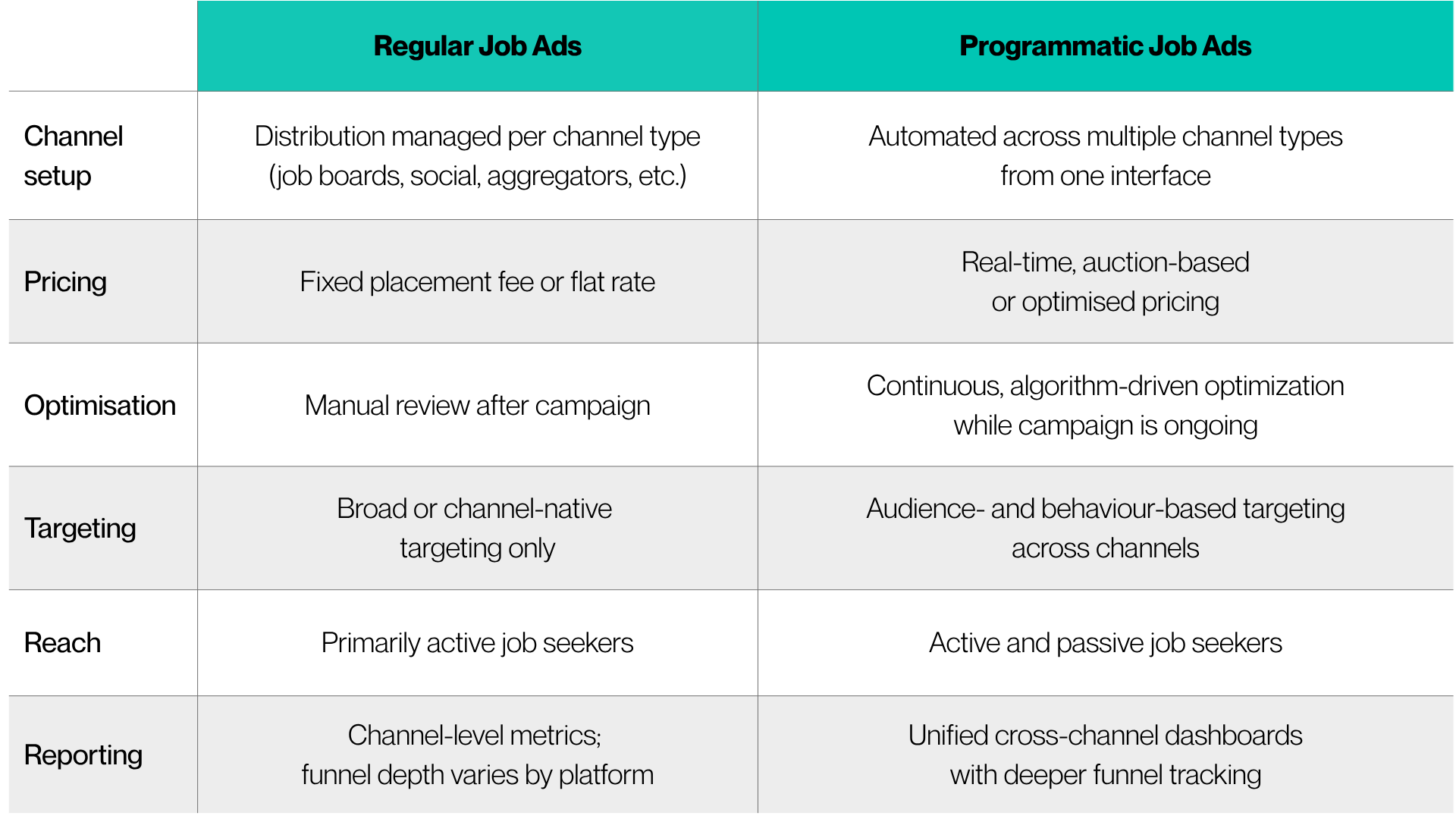
The table summarizes the practical gap between “posting a job” and “programmatically advertising a job.”
Jobiqo AIR is built to close that exact gap: it replaces manual, channel-by-channel posting with one automated layer that helps to handle pricing, optimization, and targeting across every channel from a single interface.
Why Job Boards Need Multi-Channel Recruitment Marketing
Fragmentation is the core challenge programmatic advertising was built to solve. Job boards, social media platforms, and search engines are all competing for the attention of a limited pool of job seekers. A U.S.-based survey of employed adults found that 62% of Gen Z and 56% of Millennials with work experience had discovered job opportunities on social media, compared with 31% of Gen X and just 12% of Boomers.
The results suggest that younger candidates increasingly treat social platforms as job search starting points alongside job boards and search engines. While patterns may differ by niche and region, these figures can be considered indicative of a shift in job seeker behavior: employers and job boards need to proactively bring jobs to wherever candidates already search for jobs, rather than relying on a single, traditional entry channel.
This fragmentation is precisely the problem Jobiqo AIR was built to solve: instead of a job board chasing five separate channel relationships, AIR consolidates them into one automated distribution layer. We give job boards access to a mix of distribution channels, including job aggregators, social media platforms such as Instagram, Facebook, LinkedIn, TikTok, and Snapchat, and retargeting channels like Google Ads, all from a single interface. Rather than requiring a job board to manage five or six separate advertising relationships, a single layer manages budget, creative, and distribution across all of them.
The commercial upside for job boards is direct. We help clients increase reach and conversions through data-driven automation, add more distribution channels through a channel mix, and give them a smart spend overview that uses predictions to boost only the jobs that actually need traffic. Multi-channel distribution is not simply about visibility, it’s about making sure budget flows toward the channels and jobs that are actually converting.
A New Channel Is Emerging: AI Chat Assistants
Social media wasn’t the last shift in where candidates start their search. AI chat assistants like ChatGPT, Claude, and Gemini are increasingly being used to search for jobs, compare roles, and in some cases even begin an application, all inside the chat interface itself. Some job platforms have already launched dedicated apps inside these assistants, and AI browser agents can now navigate job boards and pre-fill applications on a candidate’s behalf.
For job boards, this doesn’t yet mean a new line item in the media plan. Billing models for this channel are still unsettled, and reach is early compared with search, social, or aggregators. But it does mean the list of places candidates “discover” a job is no longer fixed. The same fragmentation logic that made social media a required channel a few years ago is starting to apply to conversational AI, and job boards that treat channel mix as a static list risk missing where search behavior goes next.
Reaching Passive Candidates Across Channels
One of the most important distinctions between programmatic and traditional recruitment advertising is who it reaches. Traditional job board postings are built to capture people already searching, and they do that well.
But as the numbers in the introduction show, a rising pool of applicants doesn’t automatically mean a rising pool of qualified ones, and a meaningful share of the strongest candidates for any given role are open to the right opportunity only if it reaches them where they already spend time. Programmatic advertising is built for exactly that audience. Programmatic systems distribute ads across the platforms passive audiences actually use day to day, rather than only the platforms active job seekers deliberately visit.
Jobiqo AIR is built to support exactly this behavior: marketing and talent acquisition teams define the strategy, brand guidelines, and target audiences, and AIR helps teams distribute jobs across the platforms where passive candidates spend time. Its AI engine generates multiple ad variations (text, video, image) so the same job doesn’t show an identical, static creative to every audience. This keeps ads native-feeling enough to stop a passive scroller, while still carrying consistent employer branding (logo, colors, tagline) across every channel.
Note on compliance: social platforms such as Meta apply special targeting restrictions to employment ads (for example, requiring a “Special Ad Category” designation that limits age, gender, and location-based targeting) to prevent discriminatory advertising. Most programmatic recruitment advertising platforms are designed to work within these rules automatically.
The EU AI Act classifies AI systems used “to place targeted job advertisements” as high-risk, in the same category as CV screening and candidate evaluation tools. Under the EU’s Digital Omnibus on AI, which entered into force on 27 July 2026, the compliance deadline for these standalone high-risk systems was pushed back from 2 August 2026 to 2 December 2027. That’s a longer runway, not a cancelled requirement: providers and deployers will still need risk assessments, technical documentation, bias testing, human oversight, and ongoing monitoring once the deadline arrives, and job boards using programmatic platforms should treat the extra time as a window to prepare rather than a reason to wait.
At Jobiqo, this is not a new conversation. We have been exploring algorithmic fairness through dedicated product development, precisely because we believe fairer matching is not just a regulatory obligation, it is better recruiting.
This section provides general context, not legal advice. Job boards should consult their legal or compliance team to confirm specific obligations under the EU AI Act and GDPR.
How Does Programmatic Job Advertising Actually Work?
At a technical level, programmatic recruitment advertising is built on the same infrastructure as broader programmatic advertising: automated auctions and rules-based systems that decide, often within milliseconds, where an ad impression should go and how much it’s worth paying for it. Two mechanisms sit at the centre of this: dynamic budget allocation and real-time bidding.
Two key systems power both of these mechanisms. On one side, a demand-side platform (DSP) helps advertisers and job platforms automatically buy ad space across many websites. On the other side, a supply-side platform (SSP) helps publishers sell their available ad space to the highest bidder.
When a job ad slot becomes available, the SSP offers it up for auction. The DSP then quickly decides whether to bid and how much to offer, all in the time it takes the page to load. Real-time bidding (RTB) is the auction itself between the SSP and DSP. Dynamic budget allocation is the strategy the DSP uses to decide how much to bid in that auction.
The Engine and the Brain: Real-Time Bidding vs. Dynamic Budget Allocation
Real-time bidding, or RTB, is the engine that drives the transaction mechanism, while dynamic budget allocation is the strategy that decides how much of the total available budget should be used for bidding at any given moment, on any given channel, for any given job.
Real-Time Bidding (RTB): The Millisecond Auction
Think of RTB as a fast digital auction house. Every single time a user opens a webpage or a mobile app, an ad slot becomes available. In the split second it takes for that page to load, a microscopic auction occurs behind the scenes.
- How it works: Many advertisers automatically review live data about the user (for example, their location, device, and the page they’re on) and place a bid.
- The result: The highest bidder wins, and their ad instantly appears on the screen. This entire process takes less than 100 milliseconds.
Dynamic Budget Allocation: The Financial Advisor
If RTB is the auction, dynamic budget allocation is the person holding the wallet. It’s an AI-driven strategy that decides when, where, and how much of your total budget to spend. Without budget allocation, an automated bidding tool might spend your entire daily budget by 8:00 AM on low-value traffic just because the clicks were cheap.
- How it works: The algorithm looks at the bigger picture. It recognizes that your target audience might engage more on Friday evenings than on Tuesday mornings.
- The result: It saves budget during slower periods and spends more during peak times, so the budget goes further.
How They Work Together
To get the results you are looking for, you need both systems working in harmony. By pairing the split-second speed of RTB auctions with the macro-intelligence of dynamic budget allocation, advertisers can ensure that not a single cent of ad spend is wasted.
We built Jobiqo AIR to reflect this two-layer approach directly. Our AI-powered intelligence explores which channels work best for which jobs and boosts smartly, and we offer an “always-on” campaign that spreads a monthly budget across multiple postings and “job boost” campaigns that commit a specific budget to a single high-priority job. The result is a system that isn’t just bidding intelligently in the moment, but is also constantly rebalancing where the overall budget should be flowing.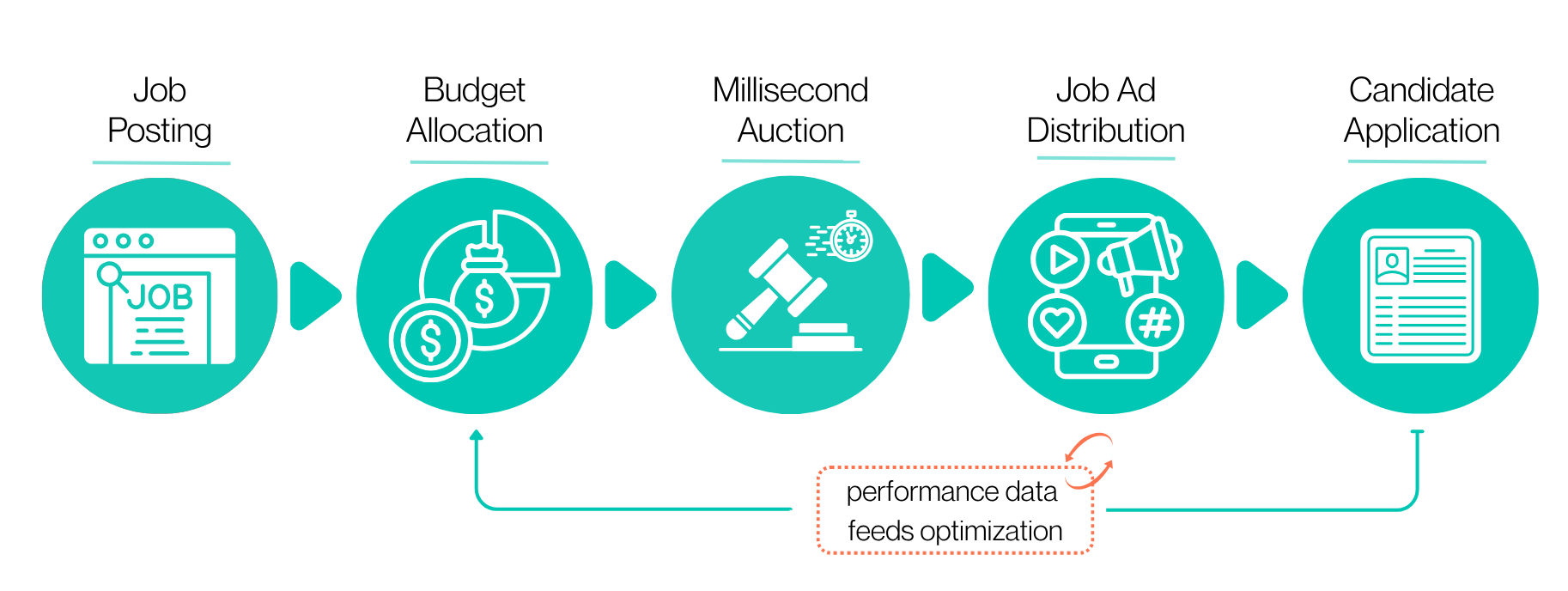
GDPR adds a separate layer of complexity around real-time bidding itself. Because RTB shares behavioral and contextual data about a user with multiple bidders within milliseconds, data protection authorities and researchers have raised concerns about whether that data flow meets GDPR’s consent and data-minimization requirements. This is a debated area of regulation across the whole ad‑tech industry, not just in recruitment. Because of that, job boards should choose platforms that are built with privacy in mind: strong consent management, tracking that doesn’t rely on third‑party cookies, and clear data‑processing agreements that spell out how user data is handled.
This section provides general context, not legal advice. Job boards should consult their legal or compliance team to confirm specific obligations under the EU AI Act and GDPR.
Can Programmatic Advertising Reduce Recruitment Costs?
Cost reduction is one of the clearest, most quantifiable benefits of programmatic recruitment advertising. A 2025 Programmatic Job Advertising study found that 74% of TA leaders cite improved quality of hire as the top benefit of programmatic job advertising, 56% cite increased applicant diversity and 51% reduced cost of candidate acquisition. That advantage happens through several compounding mechanisms rather than a single lever:
- Automated optimization reduces wasted spend. Instead of a fixed budget running for a fixed period regardless of results, programmatic systems continuously shift spend toward the channels that convert.
- Predictive analytics prevent overspending on jobs that don’t need it. By using predictive analytics, historical data, and job-seeker information, jobs are automatically distributed to the sites where they’ll perform best, rather than applying the same budget uniformly to every posting.
- Passive-audience targeting improves quality per dollar spent. Because programmatic systems can reach passive candidates who wouldn’t otherwise see a job at all, the same budget can produce a stronger, more qualified applicant pool rather than just more clicks.
- Performance is monitored and optimised continuously, using machine learning that leverages job attributes and historical data to predict performance and keep spend aligned with results rather than letting budget sit in underperforming channels.
Together, these mechanisms explain why programmatic job advertising focuses on cost-efficient reach, tied to actual applications and recruiting outcomes, rather than reach for its own sake. For context on scale, a 2026 benchmark report, drawn from more than 300 million clicks and 27 million applications across nearly 1,200 employers, put the average cost-per-hire at $851.
CPC vs. CPA: Choosing the Right Pricing Model for Job Advertising
Pricing models are where the cost conversation becomes concrete. For job boards and recruitment marketers running programmatic campaigns, choosing the right model is one of the most important decisions.
Before you even get to cost‑per‑click (CPC) or cost‑per‑application (CPA), most programmatic auctions are priced on a cost‑per‑thousand‑impressions basis, often shortened to CPM. “Mille” means thousand, so CPM is simply the cost for every 1,000 times an ad is shown.
This is the layer that real‑time bidding (RTB) works on: every time an ad space is auctioned, the winning bid is usually expressed as a CPM. You calculate it by taking your total spend, dividing it by the number of impressions (times the ad was shown), and then multiplying by 1,000.
CPM is useful when your main goal is visibility and employer branding, getting your job in front of as many people as possible. But on its own, it doesn’t tell you whether those impressions led to clicks or applications. That’s why CPC (paying per click) and CPA (paying per acquisition) exist: they tie cost more directly to recruiting outcomes that matter to job boards and employers.
What Is the Difference Between a CPC and a CPA Model for Job Posting?
CPC, or cost-per-click, is a pricing model where the advertiser pays every time someone clicks the job ad, regardless of what happens after that click. It is calculated by dividing total campaign cost by the number of clicks generated (CPC = Total Spend ÷ Clicks).
CPA, or cost-per-acquisition (sometimes cost-per-application in a recruitment context), is a pricing model where the advertiser only pays once a defined action is completed, typically a completed job application, not just a click. It is calculated by dividing total campaign cost by the number of completed actions (CPA = Total Spend ÷ Applications), tying spend directly to the recruiting outcome the advertiser actually cares about.
The practical difference for a job board is about where the risk sits. With CPC, a job board pays for interest: every visitor who clicks, even if a large share of those clicks never turn into an application. With CPA, the job board only pays once someone has actually applied, shifting more of the performance risk onto the channel or platform serving the ad.
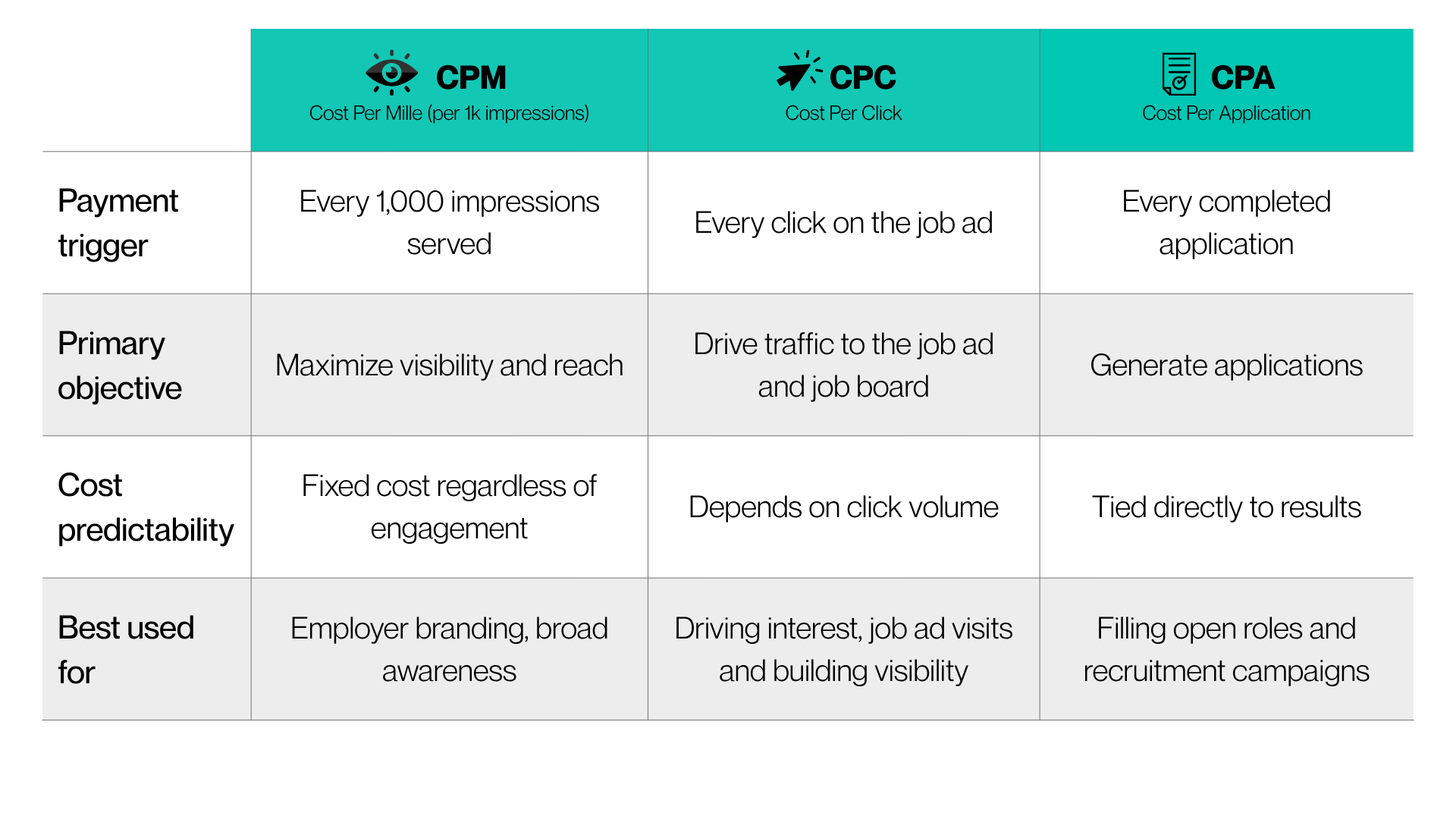
The table summarizes the key differences between CMP, CPC and CPA pricing models.
What Are the Benefits of Using a CPA Model for Recruitment Advertising?
For most job boards and employers, a CPA model tends to be the more attractive option when the goal is genuinely about filling roles rather than driving general traffic.
- Better budget predictability tied to real recruiting outcomes. Because cost is linked to conversions rather than to variable click volume, a job board can plan budget with more confidence.
- Higher return on ad spend. CPA ties spend directly to a measurable outcome, so every dollar spent is connected to an actual application rather than just a view or a click.
- Stronger focus on quality over volume. CPA campaigns push targeting and creative toward the audiences most likely to actually apply, not just the audiences most likely to click.
- More effective at the bottom of the recruitment funnel. CPA-style models work best with audiences already engaged with the brand or role, making them well suited to job boost-style campaigns.
This is exactly the logic behind Jobiqo AIR’s dual campaign structure: always-on, CPA-optimized campaigns for steady, cost-efficient volume, and job boost campaigns for situations that need targeted visibility on a specific, harder-to-fill role.
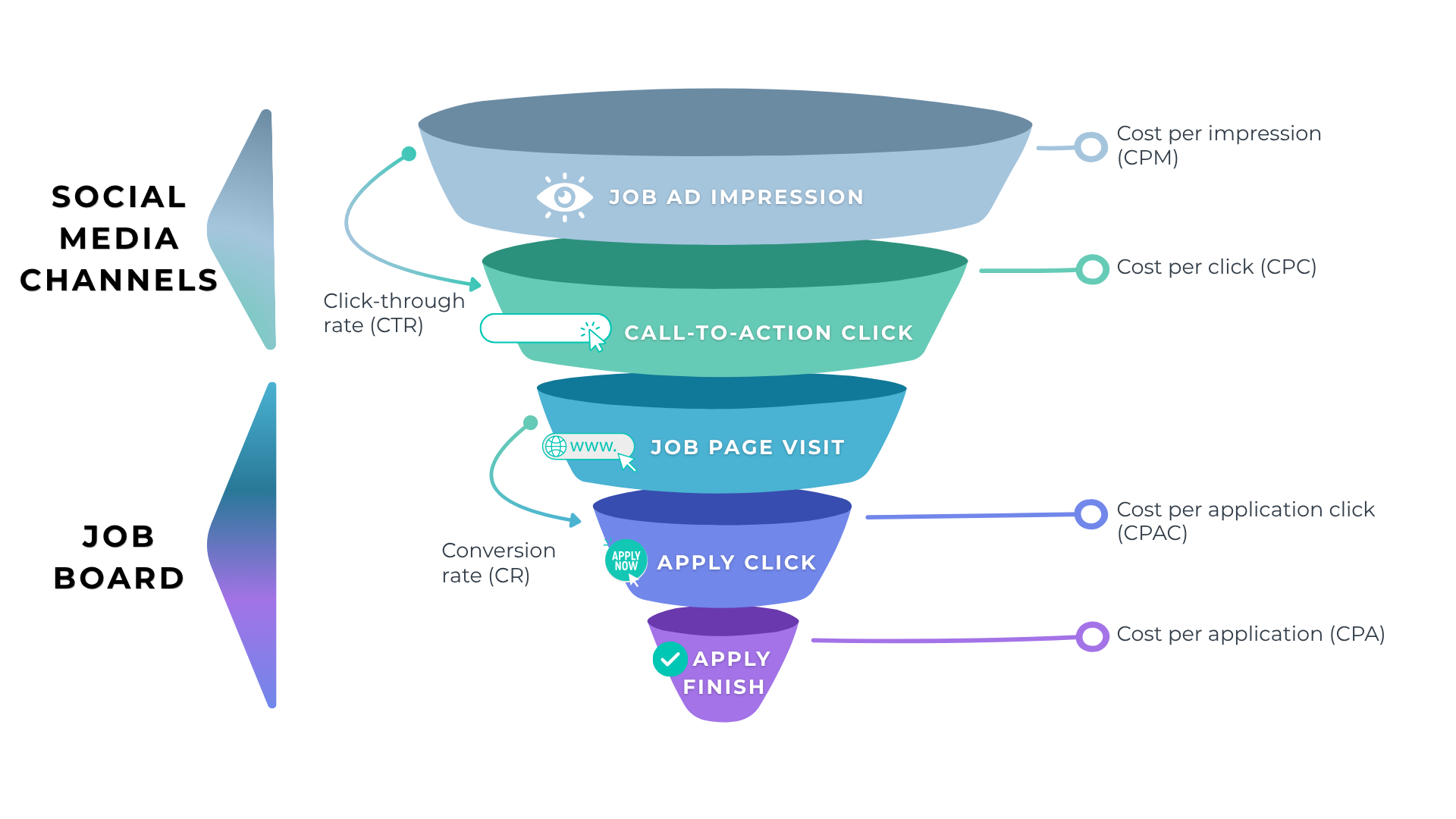
A representation of a candidate engagement funnel.
Optimizing beyond Application
CPA already shifts the focus toward quality over volume by tying spend to a completed application rather than a click. The next layer of that same logic is starting to take shape across the industry: instead of treating every completed application as equally valuable, platforms are increasingly able to distinguish a qualified application from an unqualified one, tracking signals like registration completion and prequalified status, and feeding that distinction back into how campaigns are optimized.
This is the idea behind newer metrics like cost-per-qualified-application (CPQA) and cost-per-qualified-hire. Rather than optimizing purely toward “did someone apply,” campaigns can be tuned toward candidates who are genuinely likely to move forward, so budget keeps shifting toward the channels and jobs producing real candidates, not just completed forms. For job boards evaluating a platform, this is quickly becoming as relevant a question as CPA vs. CPC: can it tell the difference between an application and a qualified one, and does it act on that difference automatically?
Turning Programmatic Advertising Into a Job Board Product
Programmatic job advertising doesn’t just reduce a job board’s own advertising cost, it can become a revenue-generating product in its own right. Job boards can package programmatic reach as a self-service upsell, letting employers choose whether to boost a single job or a whole group of jobs, directly inside the platform they already use to post roles.
This is a meaningful shift in how job boards think about monetization. Rather than treating advertising reach as a fixed feature bundled into a subscription, it becomes a flexible, purchasable product that employers control themselves, tied to measurable outcomes like reach and application performance.
We saw this play out directly with Nurses.co.uk, which increased its self-service revenue by 172.5% year-on-year (with monthly averages reaching 2.72x the previous year’s level) after they integrated recruitment marketing into their self-service product offering.
Measuring and Optimizing Recruitment Ad Performance
None of the cost or reach benefits described above are meaningful without transparent analytics. Unified tracking sits at the centre of how programmatic recruitment advertising is managed day to day.
Jobiqo AIR is managed in a single, GDPR-compliant, server-side-capable tracking system that collects traffic data from every channel a job is advertised on. This allows direct performance comparison across channels that would otherwise report results in different dashboards with different metrics.
This unified view is what makes real-time optimization possible. Clients get data insights through dashboards, giving job boards a concrete, comparable view of where the budget is working hardest.
What to Look for in a Programmatic Recruitment Advertising Platform
Not every programmatic solution is built for the realities of a job board. Before adopting one, it’s worth evaluating a few criteria that consistently separate effective platforms from generic ad-tech wrapped in recruiting language.
- ATS and job board integration. The platform should plug directly into the job board’s existing posting workflow, not require a separate login or manual export/import step. Programmatic advertising delivers the most value when it’s embedded into the tool job board operators already use daily, rather than a disconnected dashboard.
- Publisher and channel reach. Look for genuine access to the channels candidates actually use, social platforms, job aggregators, and display/retargeting networks, rather than a single ad exchange rebranded as “programmatic.”
- Transparent, real-time reporting. Spend and performance data should be visible in one place, broken down by channel and by job, not buried in per-channel dashboards that require manual reconciliation.
- Pricing model flexibility. The platform should support both CPC and CPA-style pricing so budget can be matched to the actual recruiting goal, whether that’s building visibility or filling a specific role.
- AI-driven optimization, not just automation. True programmatic platforms continuously reallocate budgets based on live performance; simple automation that just posts to more channels without adjusting spend isn’t the same thing.
How Jobiqo AIR Supports Programmatic Recruitment Advertising
Jobiqo AIR brings together everything described in this guide into a single platform: AI-powered automation, multi-channel distribution across social media, aggregators and display, unified tracking and dashboards, flexible always-on and job boost campaign types, and a self-service structure that lets employers boost individual jobs or entire groups of postings.
"The outcome for customers is a one-stop-shop service that unlocks effective paid traffic from job aggregators, social media, and display networks via one interface, driving more quality candidates to job boards in a cost-efficient way".
What sets AIR apart from a generic programmatic advertising tool is that AIR is built and continuously optimized specifically for job boards and job advertising.
For job boards deciding whether to build multi‑channel recruitment marketing in‑house or adopt a purpose‑built platform, that specialization, combined with greater efficiency in traffic acquisition and access to passive audiences, is the core value proposition AIR delivers.
To explore how this works for your specific job board and needs, contact our Jobiqo AIR team.