The EU AI Act Gets a Practical Update: What Job Boards Need to Know


Regulation rarely moves at the same pace as the technology it is trying to govern. The EU AI Act is no exception. When it entered into force in August 2024 as a risk-based rulebook for artificial intelligence, it set out an ambitious timetable. One that, in hindsight, outpaced the practical infrastructure needed to support it. The technical standards were still being developed. National supervisory bodies were still getting organised. And the market, including the online recruiting sector, was still working out what compliance would actually look like in practice.

That is the context behind the Digital Omnibus on AI. Proposed by the Commission in November 2025 and adopted as a Council negotiating position on 13 March 2026, the Omnibus package reached a full trilogue political agreement on 7 May 2026, was formally adopted, and entered into force on 27 July 2026 as Regulation (EU) 2026/1744, following publication in the Official Journal on 24 July 2026. It is not a rollback of the AI Act, it is a recalibration. More realistic timelines, simpler administrative requirements, and stronger support for growing businesses, all while keeping the core protections firmly in place.

For job board operators and online recruiting platforms, the picture is now much clearer: this is primarily about giving the market more realistic time to prepare, not about removing the core obligations. The central change is the delay for high-risk AI obligations. Under the agreed Omnibus text, stand-alone high-risk AI systems would need to comply by 2 December 2027, while high-risk AI embedded in regulated products would follow by 2 August 2028. 

📌 Update: The Digital Omnibus (Regulation (EU) 2026/1744) was published in the Official Journal on 24 July 2026 and entered into force on 27 July 2026. This is now confirmed, in-force law, not a pending proposal. Importantly, the Omnibus never delayed the transparency obligations under Article 50: those took effect exactly as originally scheduled, on 2 August 2026. Only the high-risk AI system requirements were pushed back, to 2 December 2027 (stand-alone) and 2 August 2028 (embedded).

On 20 July 2026, the European Commission adopted final Guidelines clarifying how the Article 50 transparency obligations apply in practice, including when AI chatbots and interactive systems must disclose their nature to users, and how deepfake and synthetic content should be labelled. For text content on matters of public interest, the relevant trigger for labelling is the date of publication; for other synthetic media (image, audio, video), it’s the date of generation. Content generated before 2 August 2026 does not need retroactive labelling under the new rules.

What the AI Act Actually Regulates in Recruiting

Before unpacking what changed, it helps to understand what was already there. The AI Act classifies AI systems by the risk they pose to people’s rights and safety. In the employment space, certain tools have always sat in the high-risk category: systems designed to place targeted job advertisements as part of a selection process, to filter applications, or to evaluate candidates.

This has never been purely about generative AI or chatbots. It is about algorithmic influence over who gets access to opportunities. As Jobiqo explored in the Job Board Revolution Report 2026, that question is becoming more pressing, not less. The market is shifting from passive listings toward outcome-driven recruiting: matching, ranking, behavioural targeting, and automated workflow support. The more a platform shapes who sees which role and who gets surfaced to an employer, the closer it moves to the regulatory boundary. And that boundary has not moved. What the Omnibus does is give platforms more time and clearer guidance to prepare for it responsibly.

The Timeline Has Shifted, The Regulations Have Not

The most tangible change is to the compliance schedule. Under the adopted Omnibus regulation, stand-alone high-risk AI systems now face a backstop deadline of 2 December 2027, while high-risk AI embedded in regulated products must comply by 2 August 2028. Stand‑alone systems are provided as their own service (for example, tools or algorithms used to rank candidates), whereas embedded systems are AI components built into a broader regulated product or suite that is certified as a whole. 

AI in recruiting remains in the high-risk category where it directly influences employment opportunities, such as targeted job ads, application filtering, or candidate evaluation. The critical point is that classification depends on what a system is designed to do, not what technology it uses. A search tool that helps candidates find relevant roles by keyword or location looks very different, from a regulatory perspective, than an algorithm that scores, ranks and filters applicants on an employer’s behalf. Getting that distinction right and documenting it,  is one of the most important things a platform can do right now.

The original timeline for implementation was always ambitious, given that the technical standards and supervisory bodies needed to support it were still being developed. This adjustment acknowledges that reality and gives more time to adhere. For job boards, the extended runway is meaningful but only if it is treated as an  opportunity rather than a reason to pause. The platforms best positioned for what follows are those that treat this period as an opportunity to weave AI governance into how their products work: documenting intended use, building in human oversight, and developing explainability for the employers and candidates who rely on their tools.

Deepfakes, Fairness and Bias

Two other strands of the Omnibus deserve attention from recruiting platforms specifically. The first is synthetic content. In a direct response to growing concerns about deepfake misuse, the Council has added an explicit prohibition on AI systems capable of generating non-consensual imagery or abusive material. For platforms that host video profiles, employer branding content or candidate introductions, this is a prompt to review content safeguards and moderation policies. Providers of synthetic content tools already on the market before 2 August 2026 have until December 2026 to meet the new marking requirements. This grace period applies only to tools placed on the market before that date, any synthetic content system launched on or after 2 August 2026 must comply with marking requirements immediately, with no grace period. Those that move early, with clear policies and visible safeguards in place, will find that doing so strengthens their trust proposition with both candidates and employers.

The second is bias detection. The Omnibus clarifies a narrow, safeguarded legal path to use special categories of personal data for detecting and correcting bias in AI systems, under strict necessity and strong technical and organisational protections. This matters for any platform using AI in screening or matching. Done carefully and with proper governance, fairness auditing becomes something a platform can demonstrate to employers, candidates and regulators alike, turning a compliance requirement into a genuine differentiator.

At Jobiqo, this is not a new conversation. We have been exploring algorithmic fairness through dedicated product development, precisely because we believe fairer matching is not just a regulatory obligation, it is better recruiting.

Smaller Platforms Get More Support

One of the quieter but important changes in the Omnibus is the extension of Small and Medium Enterprise (SME) support measures. A category that covers many scaling job board businesses that have grown beyond classic SME thresholds but are not yet large enterprises. Simplified documentation templates, proportionate quality management requirements, lower fine ceilings and priority access to regulatory sandboxes all now extend to this group.

After all, some of the most meaningful product innovation happens at precisely this stage of growth, and it makes sense for regulation to reflect that.

Use The Time as a Design Window, not a Pause Button

The trilogue negotiations concluded on 7 May 2026 with a political agreement between the European Parliament, the Council, and the Commission. The text was formally adopted and published in the Official Journal on 24 July 2026 as Regulation (EU) 2026/1744, entering into force on 27 July 2026. The EU is not retreating from AI oversight in recruiting. It is building a framework designed to last and giving the market enough time to meet it properly.

  • Use the timeline to build, not just comply. The extended deadlines are an invitation to integrate AI governance into your product roadmap thoughtfully, starting with the areas that matter most: transparency in matching logic, candidate control over data usage, and clear communication about how AI supports rather than replaces human decisions in hiring. Document intended use, data flows and human oversight points now, well before the 2027 deadline creates pressure to rush. And if bias detection involving sensitive data is on your roadmap, design the governance framework from day one strict access controls, minimal retention, and a clear justification record built in from the start.

  • Turn trust into differentiation. With new prohibitions on harmful synthetic content and clearer bias mitigation pathways, job boards that proactively address these areas can stand out. Introduce clear labelling where AI is used in job recommendations, candidate suggestions or branded content, especially when generative tools are involved. Consider publishing plain-language explainers about your AI practices or offering employers insights on how your tools support fair, efficient hiring.

  • Leverage support mechanisms early. Engage with national competent authorities, explore regulatory sandboxes for testing innovative features, and use the simplified documentation templates once published. National competent authorities are required to provide guidance to SMEs and SMCs on implementation. 

At Jobiqo, we have never seen regulation as something to manage around. We see it as a prompt to build better and to lead by example. Platforms where AI genuinely supports human decision-making, where candidates feel seen and treated fairly, and where employers get tools they can trust. The Omnibus gives the market more time and more clarity. The question is simply what you choose to do with both.


Further reading: 

Heise Online — Omnibus AI Act | EU AI Act Implementation Timeline | Council Press Release, 13 March 2026

How Nurses.co.uk increased self-service revenue by 172.5% after moving to Jobiqo

A clearer purchasing journey, stronger product presentation and integrated recruitment marketing helped Nurses.co.uk more than double its self-service revenue in a challenging UK recruitment market.

Nurses.co.uk, part of the Niche Jobs group, operates specialist recruitment platforms for the UK healthcare and care sectors. Following its move to Jobiqo, self-service revenue for the equivalent November-to-June period increased by 172.5% year-on-year, with the monthly average reaching 2.72x the previous year’s level.

When the business moved to Jobiqo, increasing self-service sales was one of the key commercial opportunities behind the migration. Recruiters needed to be able to understand products quickly, choose the right option with confidence and complete purchases without friction.

Eight months after launch, the commercial impact had become difficult to overlook.

The improvement came during a challenging period for the UK recruitment market, when other revenue streams were under considerable pressure.

“It is encouraging to see that the migration is already translating into measurable commercial results, especially at a much-needed time for our business.”
Matt Farrah, Founder, Niche Jobs

Turning self-service into a meaningful growth channel

Several factors influence commercial performance, and platform technology cannot take sole credit for revenue growth. However, the Nurses.co.uk team believes the new customer experience has made a material difference.

The point-of-sale presentation is more professional, helping recruiters clearly understand product value before purchasing. The buying journey is cleaner, with a guided workflow, clearer product choices and a straightforward payment process.

For a self-service model, these details matter. Customers must feel confident in their decisions and clear about expected outcomes.

The new platform makes that decision easier.

“The stronger point-of-sale design engenders more trust in us and in the anticipated performance. Combined with a cleaner purchasing journey and easier payment structure, it has given customers much more confidence to purchase online.”
Matt Farrah, Founder, Niche Jobs

One recent transaction illustrates the change: a customer completed a high-value bundled purchase in a single self-service order, something that was previously far less common.

Adding multi-channel reach with Jobiqo AIR

The migration also connected the Nurses.co.uk self-service journey with Jobiqo AIR (Automated Intelligent Reach), Jobiqo’s automated recruitment marketing solution.

Jobiqo AIR helps job boards and recruiters extend the reach of vacancies beyond the traffic already coming to their own website. Jobs can be promoted across additional channels such as job aggregators, Google and social media, depending on the campaign and target audience.

This is particularly relevant in a market where relying only on organic job board traffic is often no longer enough. Many suitable candidates are not actively visiting job sites every day. They may instead encounter a relevant vacancy while searching on Google, browsing social media or using another recruitment platform.

Jobiqo AIR is designed to make these additional channels easier to access and manage. Rather than requiring each recruiter to set up separate advertising accounts, campaigns and tracking processes, the distribution can be embedded directly into the job board’s product and purchasing journey.

For Nurses.co.uk, this means recruiters can buy a standard job advertisement and add broader promotion through channels such as Meta and Google as part of the same transaction.

Learn more about Jobiqo AIR and automated cross-channel programmatic recruitment marketing.

From a job posting to a recruitment campaign

The integration changes the nature of the product being sold.

Instead of offering only space on a job board, Nurses.co.uk can provide recruiters with a more complete recruitment advertising package. A vacancy can be published on Nurses.co.uk and then promoted to additional audiences through paid search and social channels.

This gives employers a clearer route to additional reach when a standard posting is not sufficient. It also enables Nurses.co.uk to serve different customer needs through a broader range of products, from straightforward job listings to enhanced multi-channel campaigns.

The early response has been positive. Customers are actively selecting the Meta and Google packages available through Jobiqo AIR, while the Nurses.co.uk team reports that promoted and upgraded jobs are generating more applications.

The improved performance matters because it supports both sides of the marketplace:

  • Recruiters receive greater reach and more applications for their vacancies.
  • Nurses.co.uk can increase the value of an individual self-service transaction.
  • Campaign delivery can be scaled without creating the same level of manual work for the sales and operations teams.

Automated recruitment marketing behind the scenes

Although the customer sees a relatively simple upgrade option, the campaign workflow behind it is more complex.

Jobiqo AIR supports the setup, distribution and management of recruitment advertising campaigns across multiple external channels. Campaign parameters, budgets and job data can be passed from the job board into the relevant advertising workflow, reducing the need for manual campaign creation.

The objective is not simply to distribute a job as widely as possible. It is to use the available budget in channels that can contribute relevant candidate traffic and applications.

For job board operators, this creates the opportunity to add programmatic recruitment marketing to their existing product portfolio without building a separate campaign management operation from scratch.

For recruiters, it provides a simpler way to access channels such as Google and social media through a supplier they already know.

Connecting e-commerce, distribution and performance

The Nurses.co.uk implementation demonstrates why recruitment marketing works best when it is connected to the job board’s e-commerce and product structure.

If multi-channel promotion sits outside the main buying process, it can be difficult to explain, sell and operate. Recruiters may need to speak to a sales representative, approve a separate campaign or manage additional suppliers.

By embedding Jobiqo AIR packages directly into the self-service workflow, Nurses.co.uk can present enhanced reach as a logical extension of the core job advertising product.

Customers can see the available options at the point of purchase, understand what additional promotion is included and complete the order within one buying journey.

That combination of clearer product presentation and integrated delivery appears to have contributed to the increase in customer confidence described by the Niche Jobs team.

Selection of Nurses.co.uk self-service products

More than a platform migration

Moving an established job board is rarely a simple technology project. Existing products, customer accounts, payment processes and operational workflows all need to continue working, while new services must be introduced without making the buying experience more complicated.

For Nurses.co.uk, the migration also involved connecting the platform’s e-commerce workflow with the campaign automation behind Jobiqo AIR.

The work required close cooperation across the Niche Jobs and Jobiqo product, engineering and commercial teams.

“Creating a workflow that works and connecting it to a complicated automation system like Jobiqo AIR was not easily achieved. A huge amount of work went into the migration, and it was a leap into the unknown with no way back. It is therefore great to be able to share these positive numbers.”
Matt Farrah, Founder, Niche Jobs

Building from a stronger commercial base

The first eight months provide an encouraging signal rather than an endpoint.

Nurses.co.uk and Jobiqo continue to refine the platform and improve how recruiters purchase and promote vacancies. The results demonstrate what happens when product design, e-commerce and recruitment marketing are aligned into a single, efficient experience.

For Nurses.co.uk, that has already turned self-service into a significantly stronger revenue channel.

For Jobiqo, it reinforces a simple principle: job board technology should not only improve how a site operates. It should help the business sell more effectively, expand the reach of its vacancies and deliver better recruitment outcomes for its customers.

Read the full story behind Nurses.co.uk’s platform migration and product strategy in our in‑depth case study.

Dennis Van Allemeersch Joins Jobiqo’s Advisory Board

Job boards and talent marketplaces are entering a new phase driven by AI, automation, and evolving candidate behavior.  Jobiqo’s core mission is to help job boards shift from basic job posting to driving tangible recruiting outcomes: better matching, wider distribution, and commercial models built on results. To strengthen this mission and bring additional strategic insight, Jobiqo is expanding its advisory board with Dennis Van Allemeersch.

Dennis brings deep experience in digital marketplaces, recruitment advertising, performance marketing and large-scale digital transformation. He most recently served as Managing Director of Aimwel, the programmatic recruitment advertising platform founded by DPG Media. Under his leadership, Aimwel supported leading job boards and recruitment marketplaces in improving their performance, reach and monetisation of their job advertising campaigns.

“Jobiqo has one of the most complete product visions I have seen in the industry. The combination of Jobiqo AIR, white-label platform technology and Search & Match is powerful because it addresses the full job board value chain. What stands out to me is not only the technology, but also the team’s understanding of job boards, their API-first thinking, their use of AI, and their genuine commitment to helping the industry flourish.”
Dennis Van Allemeersch

With his appointment, Dennis joins Jobiqo’s Advisory Board alongside Lou Goodman (formerly Monster) and Bernhard Deussner (formerly Indeed), who joined the board earlier this year. Together, they will support Jobiqo’s strategic direction as the company continues to scale its job board software, Jobiqo AIR performance marketing solution, and AI-powered Search & Match capabilities.

“Dennis understands the job board industry from the inside out. He combines marketplace thinking, performance marketing expertise and a very pragmatic understanding of what job boards need to compete. As more platforms move away from traffic and job postings towards measurable recruiting outcomes, his perspective will be highly valuable for Jobiqo and our clients.”
Martin Lenz, CEO of Jobiqo.

This appointment comes at a time when many job boards are rethinking their role in the recruitment value chain. Employers increasingly expect measurable results, candidates demand more relevant experiences, and job boards need stronger technology to manage reach, matching, performance and monetisation across the full funnel.

Jobiqo’s strategy is to help job boards respond to this shift with a more complete operating model: white-label job board software, programmatic distribution through Jobiqo AIR, AI-powered Search & Match, and the tools needed to optimise for qualified applications rather than volume alone.

Programmatic recruitment advertising is becoming part of a broader performance layer for job boards,” added Martin Lenz. “It is no longer enough to buy traffic efficiently. The real question is how job boards turn reach into relevant candidates, qualified applications and sustainable commercial models. Dennis will help us sharpen that thinking even further.”

Dennis brings broad expertise in disruptive digital innovation, international market entry, financial turnarounds, complex transformations, and building multinational digital businesses. As CEO at Beslist.nl, the largest price comparison website in the Netherlands and Belgium, he brings marketplace experience and insights that will support Jobiqo as we continue evolving from a software provider into a broader ecosystem partner for job boards and talent marketplaces.

Learn more about Jobiqo's industry thought leadership in the Job Board Revolution Report created together with Lou Goodman.

Programmatic Job Advertising: The Complete Guide for Job Boards

Applications are up. Hiring still isn’t easier. US applicants per open role have doubled since 2022, yet two-thirds of recruiters say finding qualified talent has actually gotten harder. More volume was supposed to fix the hiring problem. It didn’t.

Part of the reason is who that volume is missing. A large share of the strongest candidates aren’t actively searching in the first place, they’re employed, comfortable, and not scrolling job boards, but still open to the right opportunity if it reaches them at the right moment. A flat-fee posting that sits in one place and waits was never built to reach that audience, and it charges the same price whether it brings in fifty qualified applicants or none.

Programmatic job advertising exists to close both gaps at once: reaching people who aren’t searching, and tying spend to results instead of placement. Yet only about a third of enterprise companies currently use it, and roughly half still say they don’t fully understand what it is. That gap between what it delivers and how many companies have actually adopted it is exactly where the opportunity sits: the market is still projected to more than double by 2031, not because everyone’s already using it, but because adoption will catch up to the results early users are already reporting.

In the 2025 Programmatic Job Advertising study, 74% of TA leaders named improved quality of hire as the top benefit of programmatic job advertising, ahead of increased applicant diversity (56%) and reduced cost of candidate acquisition (51%). None of this makes job boards obsolete. It gives job boards a way to extend their reach beyond their own listings, tapping into the same channels the rest of digital advertising already uses, helping employers reach further and get better recruiting outcomes than a posting could deliver alone.

This guide walks through what programmatic recruitment advertising actually is, how it differs from regular recruitment advertising, how dynamic budget allocation and real-time bidding work, how CPC and CPA models compare, and how job boards can turn all of this into a measurable, cost-efficient recruiting outcome rather than just more traffic.

Key takeaways

  • Programmatic recruitment advertising automates channel selection, bidding, and budget allocation in real time, regular job board posting is a one channel ad.
  • It’s one of the most effective ways to reach candidates who aren’t actively searching, a meaningful share of the workforce that a single job board listing won’t reach on its own.
  • Two mechanisms power it: real-time bidding (RTB), the millisecond auction that decides which ad wins an impression, and dynamic budget allocation (DBA), the strategy that decides how much budget to commit to that auction at any given moment.
  • CPA (cost-per-application) pricing shifts financial risk away from the advertiser compared with CPC (cost-per-click), because payment only happens after a completed application.
  • Because payment only occurs after a completed application, CPA (cost‑per‑application) pricing shifts more financial risk away from the advertiser compared with CPC (cost‑per‑click), where every click is billed regardless of whether it leads to an application.
  • Programmatic job advertising can also become a monetizable job board product. Nurses.co.uk embedded it directly into the purchasing flow, and this contributed to a 172.5% year‑on‑year increase in self‑service revenue.

What Is Programmatic Job Advertising?

Programmatic advertising is the process of buying and selling digital advertising space using algorithms and, increasingly, artificial intelligence. Software supports those decisions in real time, helping to determine which ad shows to which audience, on which channel, and at what price.

Applied to recruitment, the same approach is used to guide when and where job ads display and how much to bid to reach the right sites, audiences, and demographics for a given role. Programmatic recruitment advertising uses technology to determine the best places to post job ads, applying algorithms to steer advertising toward the right candidates at the right time, based on the goals and constraints set for each job advertising campaign.

Jobiqo built this category of capability into its own solution, Jobiqo AIR, short for Automated Intelligent Reach, which gives job boards automated and intelligent reach for job postings, accessing job aggregators, social media, and display networks in one single interface. The core idea mirrors the wider category: turn a static job posting into an active, optimized advertising campaign that goes out and finds the right audience, rather than waiting for candidates to come find the job. The solution allows clients to reduce traffic acquisition costs, target passive audiences, and grow revenue with new programmatic advertising products.

How Is Programmatic Recruitment Advertising Different From Regular Recruitment Advertising?

Regular, or traditional, recruitment advertising typically means manually posting a job to one or more job boards, or buying a fixed placement for a set price and duration, regardless of how well it performs. The advertiser commits a budget upfront, the placement runs, and optimization, if it happens at all, is done manually by a person reviewing results after the fact.

Programmatic recruitment advertising works differently at almost every stage of that process. Algorithms evaluate available ad inventory across many channels in real time, automatically deciding which channel, audience segment, and price makes sense for each job. They continuously adjust based on live performance data rather than a one-time buy.
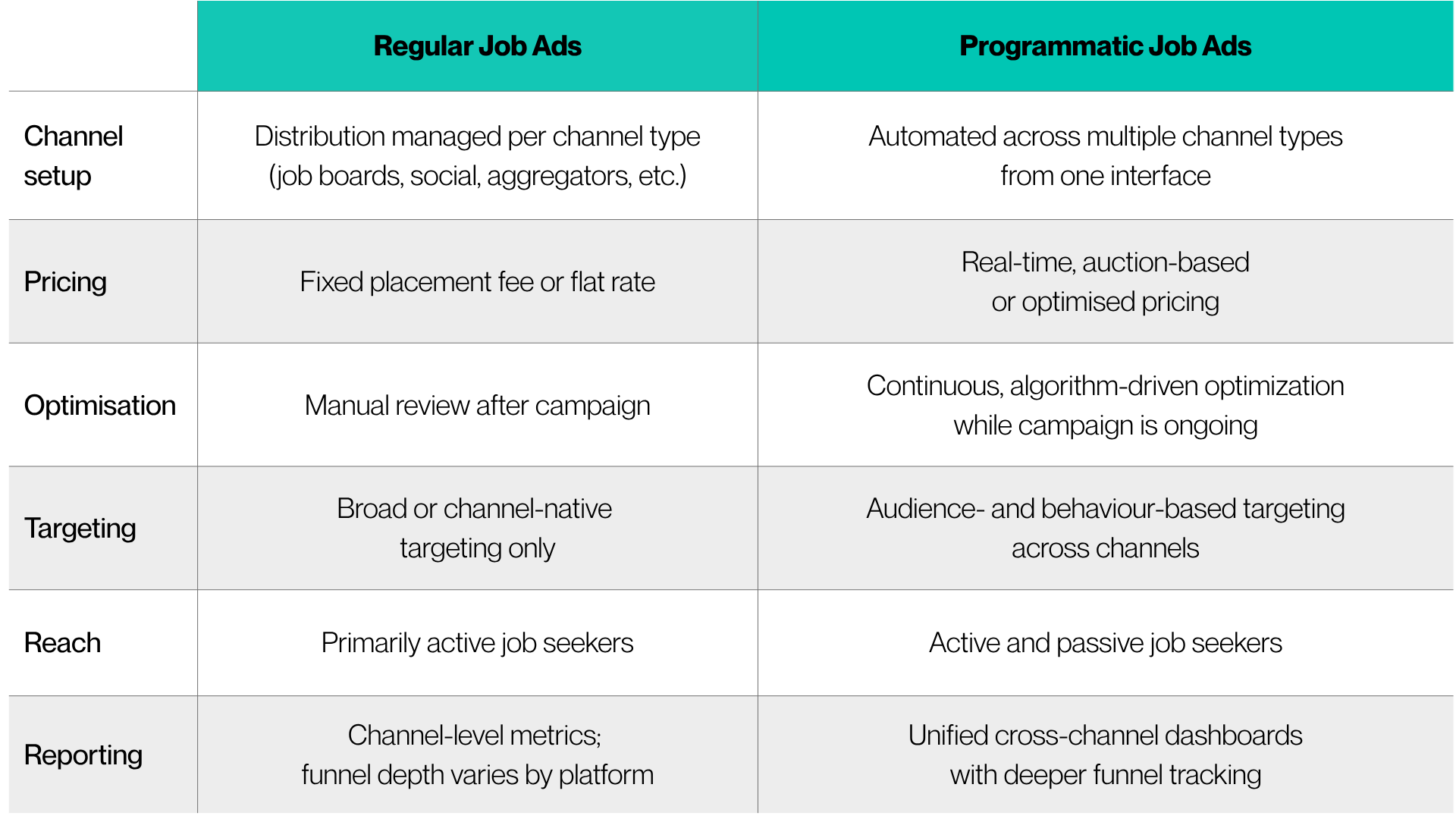
"Regular vs programmatic job ads comparison: pricing, targeting, optimization, reach, and reporting differences"

The table summarizes the practical gap between “posting a job” and “programmatically advertising a job.”

Jobiqo AIR is built to close that exact gap: it replaces manual, channel-by-channel posting with one automated layer that helps to handle pricing, optimization, and targeting across every channel from a single interface.

Why Job Boards Need Multi-Channel Recruitment Marketing

Fragmentation is the core challenge programmatic advertising was built to solve. Job boards, social media platforms, and search engines are all competing for the attention of a limited pool of job seekers. A U.S.-based survey of employed adults found that 62% of Gen Z and 56% of Millennials with work experience had discovered job opportunities on social media, compared with 31% of Gen X and just 12% of Boomers

The results suggest that younger candidates increasingly treat social platforms as job search starting points alongside job boards and search engines. While patterns may differ by niche and region, these figures can be considered indicative of a shift in job seeker behavior: employers and job boards need to proactively bring jobs to wherever candidates already search for jobs, rather than relying on a single, traditional entry channel.

This fragmentation is precisely the problem Jobiqo AIR was built to solve: instead of a job board chasing five separate channel relationships, AIR consolidates them into one automated distribution layer. We give job boards access to a mix of distribution channels, including job aggregators, social media platforms such as Instagram, Facebook, LinkedIn, TikTok, and Snapchat, and retargeting channels like Google Ads, all from a single interface. Rather than requiring a job board to manage five or six separate advertising relationships, a single layer manages budget, creative, and distribution across all of them.

The commercial upside for job boards is direct. We help clients increase reach and conversions through data-driven automation, add more distribution channels through a channel mix, and give them a smart spend overview that uses predictions to boost only the jobs that actually need traffic. Multi-channel distribution is not simply about visibility, it’s about making sure budget flows toward the channels and jobs that are actually converting.

Reaching Passive Candidates Across Channels

One of the most important distinctions between programmatic and traditional recruitment advertising is who it reaches. Traditional job board postings are built to capture people already searching, and they do that well.

But as the numbers in the introduction show, a rising pool of applicants doesn’t automatically mean a rising pool of qualified ones, and a meaningful share of the strongest candidates for any given role are open to the right opportunity only if it reaches them where they already spend time. Programmatic advertising is built for exactly that audience. Programmatic systems distribute ads across the platforms passive audiences actually use day to day, rather than only the platforms active job seekers deliberately visit.

Jobiqo AIR is built to support exactly this behavior: marketing and talent acquisition teams define the strategy, brand guidelines, and target audiences, and AIR helps teams distribute jobs across the platforms where passive candidates spend time. Its AI engine generates multiple ad variations (text, video, image) so the same job doesn’t show an identical, static creative to every audience. This keeps ads native-feeling enough to stop a passive scroller, while still carrying consistent employer branding (logo, colors, tagline) across every channel.

Note on compliance: social platforms such as Meta apply special targeting restrictions to employment ads (for example, requiring a “Special Ad Category” designation that limits age, gender, and location-based targeting) to prevent discriminatory advertising. Most programmatic recruitment advertising platforms are designed to work within these rules automatically.


The EU AI Act classifies AI systems used “to place targeted job advertisements” as high-risk, in the same category as CV screening and candidate evaluation tools. Under the EU’s Digital Omnibus on AI, which entered into force on 27 July 2026, the compliance deadline for these standalone high-risk systems was pushed back from 2 August 2026 to 2 December 2027. That’s a longer runway, not a cancelled requirement: providers and deployers will still need risk assessments, technical documentation, bias testing, human oversight, and ongoing monitoring once the deadline arrives, and job boards using programmatic platforms should treat the extra time as a window to prepare rather than a reason to wait.

At Jobiqo, this is not a new conversation. We have been exploring algorithmic fairness through dedicated product development, precisely because we believe fairer matching is not just a regulatory obligation, it is better recruiting.

This section provides general context, not legal advice. Job boards should consult their legal or compliance team to confirm specific obligations under the EU AI Act and GDPR.

How Does Programmatic Job Advertising Actually Work?

At a technical level, programmatic recruitment advertising is built on the same infrastructure as broader programmatic advertising: automated auctions and rules-based systems that decide, often within milliseconds, where an ad impression should go and how much it’s worth paying for it. Two mechanisms sit at the centre of this: dynamic budget allocation and real-time bidding.

Two key systems power both of these mechanisms. On one side, a demand-side platform (DSP) helps advertisers and job platforms automatically buy ad space across many websites. On the other side, a supply-side platform (SSP) helps publishers sell their available ad space to the highest bidder.

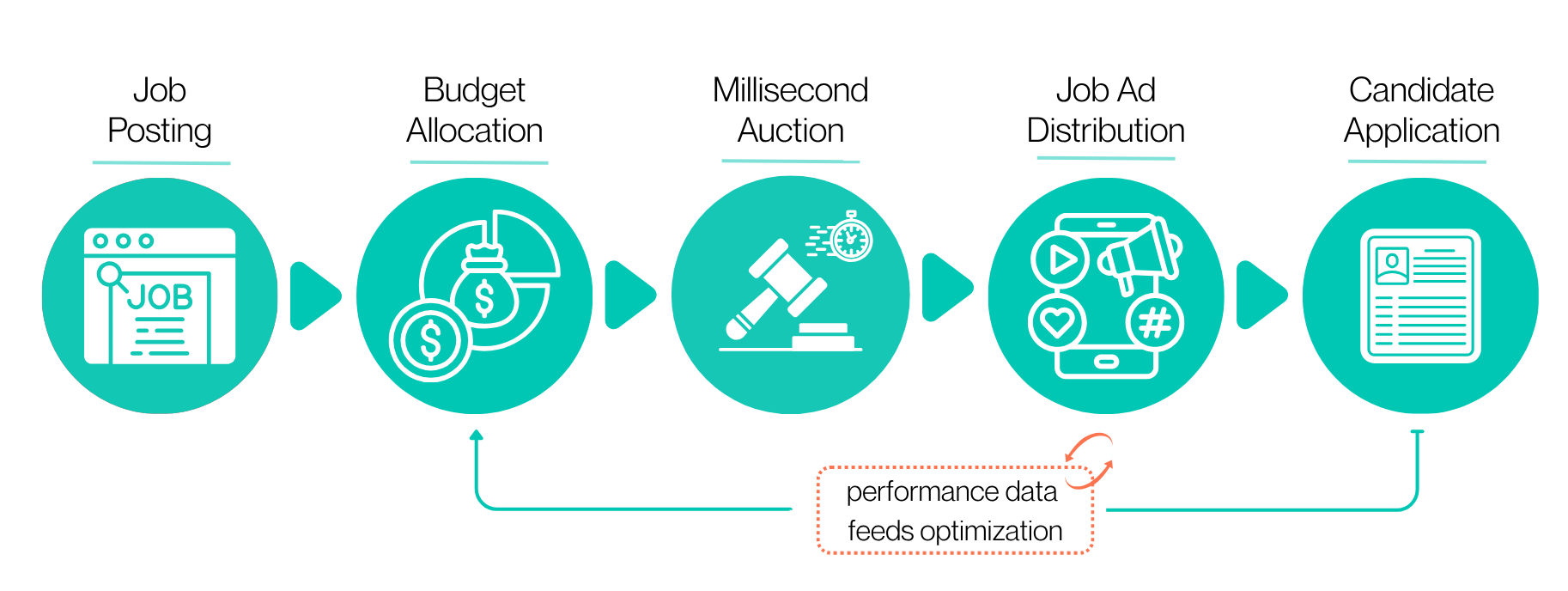
When a job ad slot becomes available, the SSP offers it up for auction. The DSP then quickly decides whether to bid and how much to offer, all in the time it takes the page to load. Real-time bidding (RTB) is the auction itself between the SSP and DSP. Dynamic budget allocation is the strategy the DSP uses to decide how much to bid in that auction.

The Engine and the Brain: Real-Time Bidding vs. Dynamic Budget Allocation

Real-time bidding, or RTB, is the engine that drives the transaction mechanism, while dynamic budget allocation is the strategy that decides how much of the total available budget should be used for bidding at any given moment, on any given channel, for any given job.

Real-Time Bidding (RTB): The Millisecond Auction

Think of RTB as a fast digital auction house. Every single time a user opens a webpage or a mobile app, an ad slot becomes available. In the split second it takes for that page to load, a microscopic auction occurs behind the scenes.

  • How it works: Many advertisers automatically review live data about the user (for example, their location, device, and the page they’re on) and place a bid.
  • The result: The highest bidder wins, and their ad instantly appears on the screen. This entire process takes less than 100 milliseconds.

Dynamic Budget Allocation: The Financial Advisor

If RTB is the auction, dynamic budget allocation is the person holding the wallet. It’s an AI-driven strategy that decides when, where, and how much of your total budget to spend. Without budget allocation, an automated bidding tool might spend your entire daily budget by 8:00 AM on low-value traffic just because the clicks were cheap.

  • How it works: The algorithm looks at the bigger picture. It recognizes that your target audience might engage more on Friday evenings than on Tuesday mornings.
  • The result: It saves budget during slower periods and spends more during peak times, so the budget goes further.

How They Work Together

To get the results you are looking for, you need both systems working in harmony. By pairing the split-second speed of RTB auctions with the macro-intelligence of dynamic budget allocation, advertisers can ensure that not a single cent of ad spend is wasted.

We built Jobiqo AIR to reflect this two-layer approach directly. Our AI-powered intelligence explores which channels work best for which jobs and boosts smartly, and we offer an “always-on” campaign that spreads a monthly budget across multiple postings and “job boost” campaigns that commit a specific budget to a single high-priority job. The result is a system that isn’t just bidding intelligently in the moment, but is also constantly rebalancing where the overall budget should be flowing.Programmatic job ad workflow: posting, budget allocation, auction, distribution, application, with feedback loop

GDPR adds a separate layer of complexity around real-time bidding itself. Because RTB shares behavioral and contextual data about a user with multiple bidders within milliseconds, data protection authorities and researchers have raised concerns about whether that data flow meets GDPR’s consent and data-minimization requirements. This is a debated area of regulation across the whole ad‑tech industry, not just in recruitment. Because of that, job boards should choose platforms that are built with privacy in mind: strong consent management, tracking that doesn’t rely on third‑party cookies, and clear data‑processing agreements that spell out how user data is handled. 

This section provides general context, not legal advice. Job boards should consult their legal or compliance team to confirm specific obligations under the EU AI Act and GDPR.

Can Programmatic Advertising Reduce Recruitment Costs?

Cost reduction is one of the clearest, most quantifiable benefits of programmatic recruitment advertising. A 2025 Programmatic Job Advertising study found that 74% of TA leaders cite improved quality of hire as the top benefit of programmatic job advertising, 56% cite increased applicant diversity and 51% reduced cost of candidate acquisition. That advantage happens through several compounding mechanisms rather than a single lever:

  • Automated optimization reduces wasted spend. Instead of a fixed budget running for a fixed period regardless of results, programmatic systems continuously shift spend toward the channels that convert.
  • Predictive analytics prevent overspending on jobs that don’t need it. By using predictive analytics, historical data, and job-seeker information, jobs are automatically distributed to the sites where they’ll perform best, rather than applying the same budget uniformly to every posting.
  • Passive-audience targeting improves quality per dollar spent. Because programmatic systems can reach passive candidates who wouldn’t otherwise see a job at all, the same budget can produce a stronger, more qualified applicant pool rather than just more clicks.
  • Performance is monitored and optimised continuously, using machine learning that leverages job attributes and historical data to predict performance and keep spend aligned with results rather than letting budget sit in underperforming channels.

Together, these mechanisms explain why programmatic job advertising focuses on cost-efficient reach, tied to actual applications and recruiting outcomes, rather than reach for its own sake.  For context on scale, a 2026 benchmark report, drawn from more than 300 million clicks and 27 million applications across nearly 1,200 employers, put the average cost-per-hire at $851.

CPC vs. CPA: Choosing the Right Pricing Model for Job Advertising

Pricing models are where the cost conversation becomes concrete. For job boards and recruitment marketers running programmatic campaigns, choosing the right model is one of the most important decisions.

Before you even get to cost‑per‑click (CPC) or cost‑per‑application (CPA), most programmatic auctions are priced on a cost‑per‑thousand‑impressions basis, often shortened to CPM. “Mille” means thousand, so CPM is simply the cost for every 1,000 times an ad is shown.

This is the layer that real‑time bidding (RTB) works on: every time an ad space is auctioned, the winning bid is usually expressed as a CPM. You calculate it by taking your total spend, dividing it by the number of impressions (times the ad was shown), and then multiplying by 1,000.

CPM is useful when your main goal is visibility and employer branding, getting your job in front of as many people as possible. But on its own, it doesn’t tell you whether those impressions led to clicks or applications. That’s why CPC (paying per click) and CPA (paying per acquisition) exist: they tie cost more directly to recruiting outcomes that matter to job boards and employers.

What Is the Difference Between a CPC and a CPA Model for Job Posting?

CPC, or cost-per-click, is a pricing model where the advertiser pays every time someone clicks the job ad, regardless of what happens after that click. It is calculated by dividing total campaign cost by the number of clicks generated (CPC = Total Spend ÷ Clicks).

CPA, or cost-per-acquisition (sometimes cost-per-application in a recruitment context), is a pricing model where the advertiser only pays once a defined action is completed, typically a completed job application, not just a click. It is calculated by dividing total campaign cost by the number of completed actions (CPA = Total Spend ÷ Applications), tying spend directly to the recruiting outcome the advertiser actually cares about.

The practical difference for a job board is about where the risk sits. With CPC, a job board pays for interest: every visitor who clicks, even if a large share of those clicks never turn into an application. With CPA, the job board only pays once someone has actually applied, shifting more of the performance risk onto the channel or platform serving the ad.

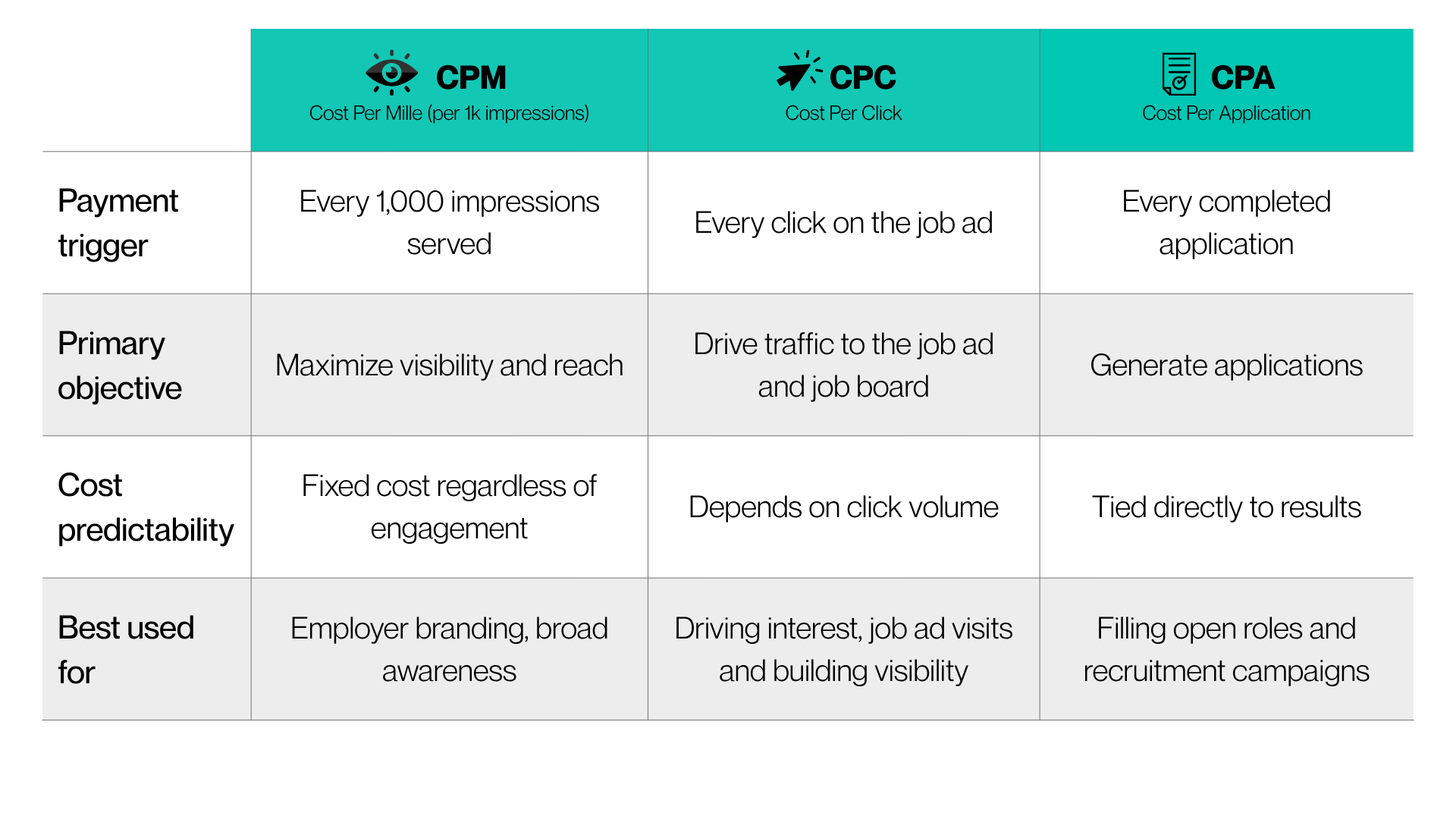
CPM vs CPC vs CPA comparison table: payment trigger, objective, cost predictability, and best use for recruitment ads

The table summarizes the key differences between CMP, CPC and CPA pricing models.

What Are the Benefits of Using a CPA Model for Recruitment Advertising?

For most job boards and employers, a CPA model tends to be the more attractive option when the goal is genuinely about filling roles rather than driving general traffic.

  • Better budget predictability tied to real recruiting outcomes. Because cost is linked to conversions rather than to variable click volume, a job board can plan budget with more confidence.
  • Higher return on ad spend. CPA ties spend directly to a measurable outcome, so every dollar spent is connected to an actual application rather than just a view or a click.
  • Stronger focus on quality over volume. CPA campaigns push targeting and creative toward the audiences most likely to actually apply, not just the audiences most likely to click.
  • More effective at the bottom of the recruitment funnel. CPA-style models work best with audiences already engaged with the brand or role, making them well suited to job boost-style campaigns.

This is exactly the logic behind Jobiqo AIR’s dual campaign structure: always-on, CPA-optimized campaigns for steady, cost-efficient volume, and job boost campaigns for situations that need targeted visibility on a specific, harder-to-fill role.

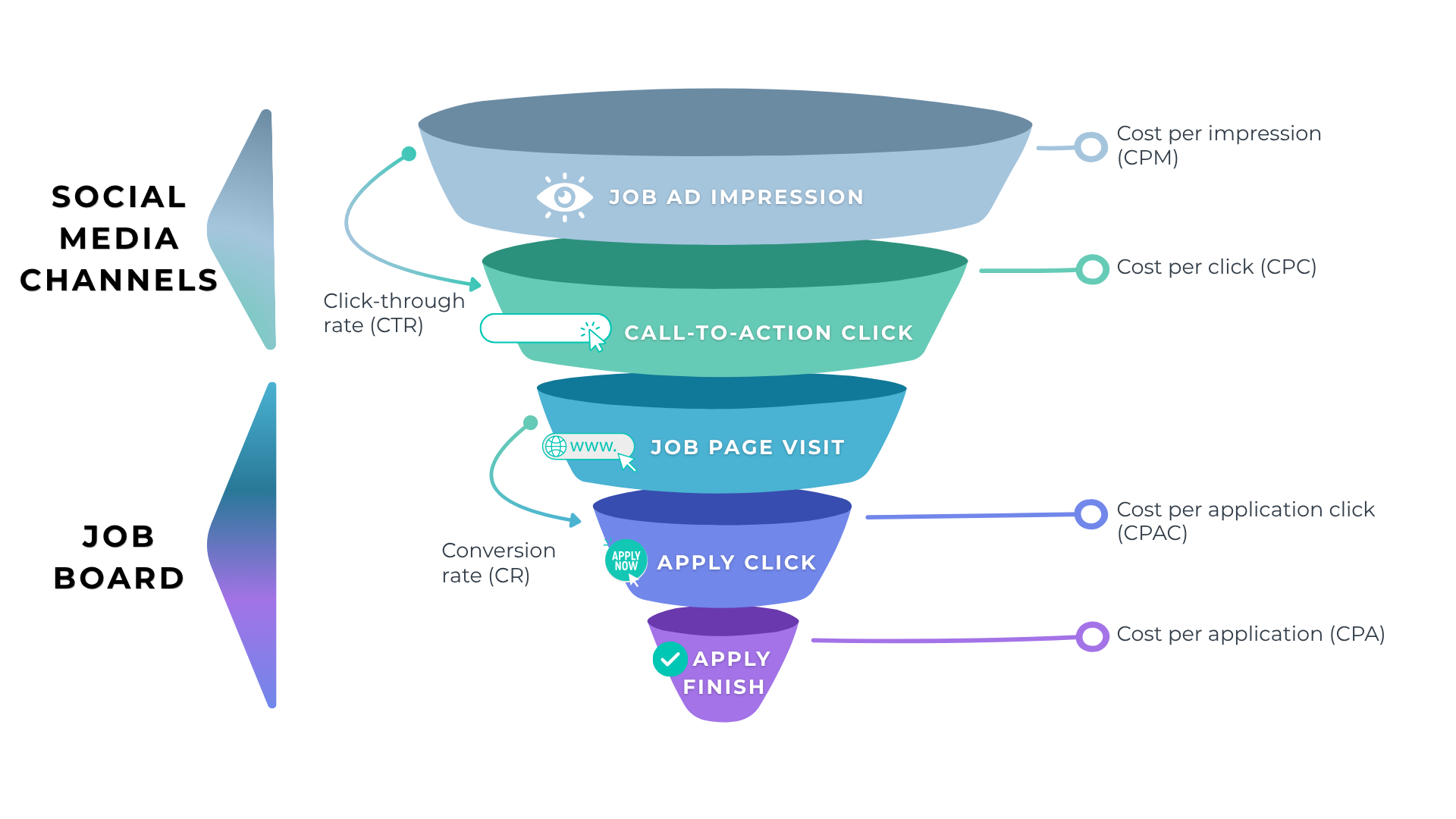
Recruitment funnel diagram: impressions, job detail views, apply clicks, apply finish, with CTR, CPAC, and CPA metrics by stage

A representation of a candidate engagement funnel.

Turning Programmatic Advertising Into a Job Board Product

Programmatic job advertising doesn’t just reduce a job board’s own advertising cost, it can become a revenue-generating product in its own right. Job boards can package programmatic reach as a self-service upsell, letting employers choose whether to boost a single job or a whole group of jobs, directly inside the platform they already use to post roles.

This is a meaningful shift in how job boards think about monetization. Rather than treating advertising reach as a fixed feature bundled into a subscription, it becomes a flexible, purchasable product that employers control themselves, tied to measurable outcomes like reach and application performance.

We saw this play out directly with Nurses.co.uk, which increased its self-service revenue by 172.5% year-on-year (with monthly averages reaching 2.72x the previous year’s level) after they integrated recruitment marketing into their self-service product offering.

Measuring and Optimizing Recruitment Ad Performance

None of the cost or reach benefits described above are meaningful without transparent analytics. Unified tracking sits at the centre of how programmatic recruitment advertising is managed day to day.

Jobiqo AIR is managed in a single, GDPR-compliant, server-side-capable tracking system that collects traffic data from every channel a job is advertised on. This allows direct performance comparison across channels that would otherwise report results in different dashboards with different metrics.

This unified view is what makes real-time optimization possible. Clients get data insights through dashboards, giving job boards a concrete, comparable view of where the budget is working hardest.

What to Look for in a Programmatic Recruitment Advertising Platform

Not every programmatic solution is built for the realities of a job board. Before adopting one, it’s worth evaluating a few criteria that consistently separate effective platforms from generic ad-tech wrapped in recruiting language.

  • ATS and job board integration. The platform should plug directly into the job board’s existing posting workflow, not require a separate login or manual export/import step. Programmatic advertising delivers the most value when it’s embedded into the tool job board operators already use daily, rather than a disconnected dashboard.
  • Publisher and channel reach. Look for genuine access to the channels candidates actually use, social platforms, job aggregators, and display/retargeting networks, rather than a single ad exchange rebranded as “programmatic.”
  • Transparent, real-time reporting. Spend and performance data should be visible in one place, broken down by channel and by job, not buried in per-channel dashboards that require manual reconciliation.
  • Pricing model flexibility. The platform should support both CPC and CPA-style pricing so budget can be matched to the actual recruiting goal, whether that’s building visibility or filling a specific role.
  • AI-driven optimization, not just automation. True programmatic platforms continuously reallocate budgets based on live performance; simple automation that just posts to more channels without adjusting spend isn’t the same thing.

How Jobiqo AIR Supports Programmatic Recruitment Advertising

Jobiqo AIR brings together everything described in this guide into a single platform: AI-powered automation, multi-channel distribution across social media, aggregators and display, unified tracking and dashboards, flexible always-on and job boost campaign types, and a self-service structure that lets employers boost individual jobs or entire groups of postings.

"The outcome for customers is a one-stop-shop service that unlocks effective paid traffic from job aggregators, social media, and display networks via one interface, driving more quality candidates to job boards in a cost-efficient way".
Martin Lenz, CEO of Jobiqo

What sets AIR apart from a generic programmatic advertising tool is that AIR is built and continuously optimized specifically for job boards and job advertising.

For job boards deciding whether to build multi‑channel recruitment marketing in‑house or adopt a purpose‑built platform, that specialization, combined with greater efficiency in traffic acquisition and access to passive audiences, is the core value proposition AIR delivers.

To explore how this works for your specific job board and needs, contact our Jobiqo AIR team.

Jobiqo to Power New Defence Careers Platform Launching in Late Spring

Launching a specialist job board in defence requires more than strong branding, it demands secure, scalable, outcome-driven technology built for a highly regulated and skills-constrained market.

That’s exactly what Jobiqo is delivering with the launch of a new careers platform dedicated to defence, set to go live in late spring.

With over 400 job platforms across 25 countries running on Jobiqo technology, Jobiqo brings proven infrastructure to ambitious niche operators. The new defence tech job board will launch as an AI-powered, performance-optimised marketplace connecting advanced manufacturers, cybersecurity firms, aerospace innovators, and dual-use startups with highly specialised talent.

We are launching this job board to strengthen the rapidly scaling defense and dual-use technology ecosystem by connecting exceptional, mission-driven talent with fast-growing companies. As the market expands faster than its talent infrastructure, our focused platform bridges specialized hiring needs with experienced operators, engineers, and investors, accelerating growth, supporting technological sovereignty, and ensuring innovation continues to advance by unlocking the right talent at the right time.
Dr. Eveline Beer, CEO and Co-Founder, Women in Defense Tech

In addition to supporting commercial defence employers, Jobiqo brings extensive experience working with veteran-focused platforms, helping organisations connect former service members with meaningful civilian careers. This expertise ensures the new platform can effectively support all types of talent and build a critical pipeline for the defence tech sector.

Built around AI-driven matching, programmatic job advertising, mobile-first UX, and advanced monetisation capabilities, the platform is designed not just to list jobs, but to deliver measurable recruiting outcomes.

Sovereignty is becoming an increasingly important topic across Europe and beyond. It’s a major issue politically and economically, and it’s also a talent challenge. There is a clear skills shortage across critical defence and technology roles. We’re committed to supporting employment in work that strengthens resilience, and helping the right people connect with organisations at the forefront of innovation in this space is both a responsibility and a privilege for us.
Martin Lenz, CEO, Jobiqo

Thinking of entering strategic verticals like defence technology?

About Women in Defense Tech 

Women in Defense Tech is a community-driven network dedicated to connecting and advancing female professionals across the defense and dual-use technology ecosystem. Embedded within a broader platform that brings together defense primes, emerging startups, investors, research & policy, armed forces and ecosystem partners, the network creates meaningful opportunities for exchange, visibility, and career growth. Through curated introductions, focused roundtables, and industry gatherings, Women in Defense Tech fosters trusted relationships and expert dialogue across all levels of the sector.

Beyond the network and community, the initiative champions equality of opportunity in one of the most strategically important industries of our time. It promotes fair access to capital, stronger representation in leadership, and inclusive participation across defense innovation. Open to all and rooted in collaboration, Women in Defense Tech strengthens both individual career pathways and the collective resilience of the ecosystem.

About Jobiqo

Jobiqo is a global technology provider for online job platforms, powering job boards for publishers, media brands, associations, universities, and recruitment organizations for more than 14 years. Today, more than 400 leading job sites in 25 countries run on Jobiqo technology, including platforms for renowned media organizations such as The New York Times.

Jobiqo helps job boards turn media reach and audience trust into measurable recruiting outcomes and sustainable revenue. By improving relevance and conversion across the funnel and by giving operators the tools to package, sell, and optimize employer products, Jobiqo enables job platforms to grow beyond listings into durable, performance-driven talent platforms.

Must-Attend Events for Job Board Owners in 2026

Must-Attend Events for Job Board Owners in 2026

Every year, the HR and job market industry offers an overwhelming number of conferences. Choosing which ones are truly worth your time isn’t easy. In 2025 alone, Jobiqo attended more than 30 conferences worldwide, so chances are, we’ve already done the legwork for you.

Based on our experience, here are our must-attend events for 2026 for both existing and aspiring job board owners.

The Future of German Media
March 11–12, 2026
📍 Hanover
A summit focused on exchange, innovation, and the future of quality journalism. The Future of German Media brings together leading figures from newsrooms, publishing houses, and the digital economy to explore the key success factors for journalism in the digital age.

Zukunft Personal Nord (ZP Nord)
March 25–26, 2026
📍 Hamburg
The northern regional edition of Europe’s leading HR expo series, ZP Nord connects HR professionals with innovative solutions, emerging trends, and practical tools across the HR ecosystem

RecBuzz Conference
April 15–16, 2026
📍 Budapest
🎟️ €200 discount with code: JOBIQO200
Focus: Global recruiting marketplaces and job boards
RecBuzz, organised by the AIM Group, is a key gathering in the recruitment industry. The conference addresses industry change and strategies for staying ahead, offering valuable networking opportunities with potential partners, investors, and industry experts. Attendees engage in discussions around challenges and opportunities for recruitment platforms. Held annually in different European cities, RecBuzz 2026 will take place in Budapest.

Zukunft Personal Süd (ZP Süd)
April 21–22, 2026
📍 Stuttgart
Another regional edition of Europe’s leading HR expo series, ZP Süd continues the mission of connecting HR professionals with innovative solutions, emerging trends, and practical tools across the HR ecosystem.

TAtech North America
May 6–8, 2026
📍 Charleston, South Carolina
🎟️ 10% discount with code: tatech10
Focus: North America and global recruiting marketplaces, job boards, recruiting tech, and HR tech
TAtech North America & The World Job Board Forum is a unique conference dedicated entirely to job boards, talent marketplaces, and talent technology solutions. Now in its 19th year, it covers ATS, CRM, conversational AI, recruitment advertising, marketing, and assessment products. Unlike traditional HR events, speakers are experienced business leaders, ensuring highly practical and relevant discussions.

Job Boards Connect – Unplugged
May 14, 2026
📍 London
🎟️ 10% discount with code: Jobiqo10
Focus: UK and global recruiting marketplaces and job boards
The Unplugged edition is known for its highly engaging format: no PowerPoint, no formal presentations—just open conversations and peer learning with industry, technology, sales, and marketing experts.
Job Boards Connect will also host the DJAx Digital Job Advertising Excellence Awards on the evening of May 14, offering job boards and vendors additional recognition for their impact on the job market.
The conference is organised by Louise Grant and Louise Triance, highly respected figures in the online recruitment industry and long-standing advocates for the job board ecosystem.

European Publishing Congress
June 17–18, 2026
📍 Vienna
Focus: Germany, Austria, Switzerland (German-language event)
The European Publishing Congress brings together Europe’s leading media professionals to present strategies, share insights, and discuss the future of the publishing industry.

TALENTpro
June 17–18, 2026
📍 Munich
TALENTpro is an expo festival that brings fresh ideas, strong community vibes, and the hottest recruiting trends to one stage. With its festival-like atmosphere, it offers a refreshing alternative to traditional trade fairs while maintaining a strong focus on exchange, innovation, and networking.

Zukunft Personal Europe (ZP Europe)
September 15–17, 2026
📍 Cologne
ZP Europe is the flagship event of the Zukunft Personal series and the largest HR expo in Europe. It provides unparalleled access to the full HR landscape, connecting established market leaders with innovative startups and future-facing solutions.

Job Boards Connect – Main Conference
October 8, 2026
📍 London
🎟️ 15% discount with code: Jobiqo15
The October edition follows a more traditional conference format, featuring keynote speakers, panel discussions, and on-stage insights from job board leaders and industry experts, all focused on the future of online recruitment.

Meet Jobiqo on the Road

Join us at these events and connect with the Jobiqo team in person. We’re looking forward to meeting you, exchanging ideas, and discussing how we can support your job board growth.


Stay tuned and follow us on LinkedIn to see where our team will be throughout the year.

Job Board Revolution? Are Job Boards Solving the Wrong Problem…

Commissioned by Jobiqo | Author: Lou Goodman

In January 2026, InfoJobs Italy shut down after two decades, crushed between Indeed’s aggregation power and LinkedIn’s network effects. This wasn’t market saturation or a casualty of a shrinking labor market. It was something far more fundamental and far more preventable …

It was marketing myopia: a company that defined itself as a job posting platform failed to realize it was actually a recruitment marketplace. That narrow self-definition limited its ability to evolve as the market shifted around it.

Theodore Levitt’s saw this coming decades ago and his classic warning has never felt more relevant:

“Railroads did not stop growing because the need for transportation declined. They stopped growing because management defined themselves as being in the railroad business rather than the transportation business.”

Job boards are making the same mistake. They focus on displaying job postings but postings aren’t the real problem customers are trying to solve:

  • Employers don’t need more applications. They need applications that convert to hires.

  • Job seekers don’t need more jobs to apply to. They need applications that convert to offers.

Moving Beyond Marketing Myopia

The traditional job board model worked when candidates applied selectively and stayed in roles for years. Today, those assumptions no longer hold, and platforms built around clicks and raw volume are struggling. The boards that succeed are the ones redefining success around recruiting outcomes:

Myopic Definition → Recruiting Outcomes-Focused

“We sell job postings” → “We enable employers to reach qualified candidates”

“We drive applicant volume” → “We deliver qualified candidates”

“We list opportunities” → “We help candidates discover roles that match their skills”

The contrast is clear. Platforms that focus on recruiting outcomes don’t just process applications, they create real value for both employers and job seekers. Those job boards won’t just survive, they’ll expand their advantage in a market that increasingly rewards quality over quantity. 

On the other hand, platforms measuring success by transactional metrics, number of job postings, applications submitted, or impressions served, are on a slow path to irrelevance. This isn’t a minor shift, it’s the difference between leading the market and being left behind. 

So, the real question isn’t anymore: “How do we get more clicks?” It’s: What outcomes are we actually delivering?

Job Boards at a Crossroads: A Timely Strategic Report

Our Job Board Revolution? Are Job Boards Solving the Wrong Problem… report examines this shift in detail, focusing on four forces that are redefining the job board model:

Defining Quality: Why employers and candidates see “quality” differently, and how misalignment drives volume over outcomes.
Power and Control: Who really owns the hiring transaction, and how infrastructure giants are reshaping the market.
Design, Trust, and Market Behavior: How short-term monetisation choices impact long-term trust and defensible positioning.
External Forces and Internal Choices: How collective behaviours created systemic dysfunction and where smart platforms can reclaim relevance.

Read the full report to discover how to transform from a transactional job board into a platform that drives recruiting outcomes.

Jobiqo Expands Advisory Board with Lou Goodman and Bernhard Deussner

As job boards and talent marketplaces enter a new era shaped by AI, automation, and shifting candidate behavior, Jobiqo’s mission is clear: to help leading job sites move beyond simply “posting jobs” toward delivering measurable recruiting outcomes through better matching, stronger reach, and outcome-based commercial models. To strengthen this mission and bring additional strategic insight, Jobiqo is pleased to welcome Lou Goodman and Bernhard Deussner to the Advisory Board.

Lou Goodman brings more than 20 years of recruitment marketing experience across agencies, platforms, and global media organisations. Having started her career at Barkers and TMP, held senior roles at MediaCom, Manning Gottlieb OMD and most recently as VP Global B2B Marketing at Monster, she combines consumer brand-building discipline with systems thinking for B2B growth. Lou also authored Jobiqo’s recent strategic report, “Job Board Revolution? Are job boards solving the wrong problem …”, helping define how job boards can evolve into modern, high-performance recruiting ecosystems.

Bernhard Deussner brings deep experience in scaling HR technology platforms globally. Over 14 years at Indeed, he held senior leadership roles across Austin, Dublin, and Singapore, supported expansion into 15 markets, and helped architect long-range planning and operational execution at scale. As a GTM leader with strong expertise in marketplace transformations and the DACH HR Tech landscape, Bernhard bridges strategic vision with commercial and organisational delivery across the US, EMEA, and APAC.

“Lou and Bernhard bring exactly the kind of strategic and operational perspective we need as we continue to scale Jobiqo in our core markets. They understand how talent marketplaces win today: by building trust, reaching audiences efficiently, and turning signals into outcomes, for employers, candidates, and the platforms that connect them.”
Martin Lenz, CEO of Jobiqo

Their appointments come at a crucial moment for Jobiqo, following the acquisition of JOBS.DE, which strengthens Jobiqo’s position in the German market and accelerates its ambition to build a modern, outcome-driven job marketplace at scale. Bernhard’s experience in building and executing go-to-market strategies across international and European markets, combined with his understanding of the HR Tech ecosystem, will be especially valuable as Jobiqo expands JOBS.DE and deepens its presence across DACH.

With Lou and Bernhard joining the Advisory Board, we are further strengthening our ability to serve job boards and media brands across 25 countries as they modernise their platforms, unlock new revenue models, and build the next generation of AI-enabled hiring experiences. We look forward to collaborating with Lou and Bernhard, whose insights will challenge and strengthen our strategic direction for Jobiqo and JOBS.DE.

Learn more about Jobiqo's industry thought leadership in the Job Board Revolution Report created together with Lou Goodman.

From Surviving to Thriving: How Job Boards Can Succeed in 2026

The online job market in 2025 did not simply change. It forced a reset. Economic uncertainty, cautious hiring behaviour, and rising operating costs exposed the limits of many long-standing job board strategies. Traffic alone was no longer a reliable growth lever, and more listings did not automatically lead to more revenue. Job boards were pushed to rethink how they attract qualified candidates, engage employers, and define real performance.

At the same time, 2025 brought much-needed clarity. It showed which growth tactics are sustainable, which technologies truly improve outcomes, and where real opportunities still exist. The platforms that performed best were not chasing volume. They were optimising for results. By focusing on quality over quantity, adopting technology with a clear return on investment, and staying adaptable as market conditions evolved, these job boards strengthened their position for what comes next.

Looking Back: What Last Year Taught Us

The past year reinforced a critical truth for recruitment platforms. Success is no longer defined by how much activity you generate, but by how effectively that activity converts into results. Posting more jobs or chasing every click has stopped being a reliable strategy. The boards that stood out were the ones that focused on the right opportunities and tracked recruiting outcomes that actually matter to employers.

In this environment, technology shifted from a convenience to a competitive advantage. Smarter search, more precise candidate matching, and automation using AI-enabled teams to move faster while concentrating effort where impact was highest. Agility proved just as important. The ability to integrate new tools, reach candidates across multiple channels, and quickly adapt workflows often determines whether a job site can capture emerging demand or miss it entirely.

Throughout all of this, the ability to engage candidates outside the job board became a key differentiator. Passive candidates are not actively looking, but they may show interest if opportunities are easy to access. Job platforms that reach candidates where they already spend time, on social media, professional networks, or other digital channels, can tap into this potential. Job boards that make it simple for candidates to engage are far more likely to turn initial curiosity into applications.

Learn more about Jobiqo's industry thought leadership in the Job Board Revolution Report created together with Lou Goodman.

Designing the Job Board Stack for 2026: Orchestrating Reach, AI & Automation

The lessons from the past year naturally define the priorities for 2026. Success will go to job boards that act strategically, focus on outcomes, and leverage tools effectively. Key focus areas include:

  • AI That Produces Results: Artificial intelligence is no longer optional. Smart matching, structured screening funnels, and predictive analytics surface the best candidates faster, reduce time-to-hire, and improve overall application quality. AI enables recruiters to make data-driven decisions, turning recruitment into a more outcome-focused process.

  • Social Media as a Strategic Channel: Passive candidates are everywhere, but reaching them requires more than posting a job. Tools like Jobiqo AIR, Social Apply, video recruiting, and targeted campaigns allow job boards to engage candidates where they already spend time online. By creating measurable, interactive campaigns, employers can nurture talent pipelines, showcase employer branding, and turn engagement into applications, making social media a strategic advantage rather than just a channel.

  • Connected Solutions, Not Silos: Open APIs, automation, and seamless integrations allow boards to respond quickly to changing market demands. Siloed tools are inefficient; connected solutions create flexibility and adaptability. Jobiqo’s product suite connects systems and channels, reduces manual work, improves efficiency, and gives employers and recruiters a single, unified view of operations, enabling faster, smarter decisions.

  • Broader, Controlled Reach: Diversifying distribution reduces reliance on single channels and ensures stronger reach with better control over talent pipelines. Jobiqo AIR lets job boards distribute postings widely while maintaining visibility and tracking performance, ensuring opportunities reach candidates across multiple platforms without losing oversight.

  • Efficiency Through Automation: Job boards need to equip recruiters with tools that make their work faster, smarter, and more focused on recruiting outcomes. Automation should go beyond saving time, it should streamline repetitive tasks, reduce manual work, and let recruiters spend more energy on engaging candidates and building relationships. In a competitive market, offering automation that truly supports recruiters is essential for sustaining growth and making recruitment results more predictable.

Equip your job board with the right solutions. Focus on business growth rather than technology pains.

Job Board Revolution: A Strategic Report Examining the Forces Reshaping Recruitment Platforms

Commissioned by Jobiqo | Author: Lou Goodman

Job boards sell applications (easy to count, easy to monetise), whilst employers want hiring outcomes, and candidates seek meaningful employment. The gap between what’s sold, what’s bought, and what’s needed is the industry’s structural fault line, revealing an operational model that, increasingly, struggles to serve either side adequately.

The labour market has transformed over recent years. The economy is sluggish, so employers have fewer jobs, making them more selective, and are deploying more AI throughout the hiring process. Candidates, facing fewer jobs, tougher competition, and rampant ghosting, use AI application tools to increase their chances. This creates a doom loop in which more AI-generated applications drive greater employer demand for AI screening, which, in turn, drives greater candidate reliance on AI applications.

The job board model that worked when average tenure was seven years, and candidates applied selectively, is straining under conditions it was never designed for, resulting in a system that optimises and monetises activity rather than outcomes.

This report examines what job boards are really selling, and whether they can redefine it for a new era before someone else does.

What's in the full report

Theme 1: Defining quality

Employers and candidates define quality differently, and both definitions are valid. Without a shared meaning of “quality,” job boards optimise for volume, the only metric both sides provisionally accept. The report examines why this isn’t just a technical problem waiting for better algorithms, but also a definitional problem rooted in diverging expectations about what employment relationships should look like.

Theme 2: Power and control

Job boards are two-sided marketplaces, but they don’t control the critical transaction. The application disappears into an ATS, the candidate often hears nothing, and the employer receives applications stripped of context with no signal about match quality or intent. The report maps where power actually lies, why it is so challenging to address systemic issues due to fragmentation, and how power is consolidating at the infrastructure layer (Google, LinkedIn, Indeed, major ATSs) even as the job board market diversifies, creating both constraints and opportunities for different types of players.

Theme 3: Design, trust and market behaviour

The tactics that maximise short-term revenue often undermine the trust that sustains long-term value, creating a monetisation paradox for job boards. The report examines how design and monetisation choices either build or corrode trust, where job boards create value in the hiring process, what prerequisites enable quality accountability, and what recruitment can learn from other marketplaces like eBay, Facebook and Groupon that either built resilience through trust or accelerated decline through extraction. It identifies which capabilities create a defensible positioning and the foundations that must be in place before transformation becomes possible.

Theme 4: External forces and internal choices

The external forces threatening to disrupt the job board (and wider recruitment) industry are consequences of the way the recruitment ecosystem has evolved. Staffing agencies, employers, ATSs, job boards, and candidates all optimise for individual short-term interests; while understandable, this collective behaviour creates the systemic dysfunction that new entrants are exploiting. The report examines what saying yes to volume meant saying no to, how it created the white space that AI platforms like HireEZ are bypassing job boards entirely to fill, and what strategic choices remain available to the job boards willing and able to make them.

Learn more about Jobiqo's industry thought leadership in the Job Board Revolution Report created together with Lou Goodman.

About the report

This is the Executive Summary of a comprehensive 20,000-word thought leadership report, developed by independent consultant Lou Goodman and commissioned by Jobiqo, that examines the structural challenges facing job boards as AI and market forces reshape recruitment.

The full report expands on these arguments with detailed analysis across four interconnected themes. Drawing on platform economics research from Platform Revolution, case studies from eBay, Amazon, LinkedIn, and Indeed, and analysis of global recruitment trends, it examines why quality has become an empty word in recruitment, why no single player can fix the system alone, how monetisation models create trust paradoxes, and what external forces are accelerating the need for change. 

Rather than prescriptive solutions, it provides diagnostic frameworks and strategic options for job boards to escape the volume trap and build defensible competitive positions through audience ownership, trust-aware design, and focusing on Recruiting Outcomes

Written for board operators, technology vendors, and industry stakeholders, the report is designed for both comprehensive and non-linear reading.

Author: Lou Goodman is an independent strategy consultant with 20+ years of experience spanning recruitment marketing agencies, consumer brand work, and B2B marketing leadership. She brings systems thinking and platform economics expertise to the recruitment industry’s challenges.

For more information:
Speaking engagements or strategic advisory: hello@lougoodman.co.uk
Connect: linkedin.com/in/lougoodman 

This executive summary may be shared freely with attribution