

The End of “Competitive Salary”: What the EU Pay Transparency Directive Means for Job Boards

The directive applies to employers hiring in the EU. But the shift it represents is already reshaping hiring well beyond EU borders.


For years, “competitive salary” has been a placeholder in job ads: a way to mention pay without revealing anything meaningful. That’s becoming harder to justify. The EU Pay Transparency Directive must now be reflected in national law across the EU, but its real significance goes beyond legal compliance. It reflects a broader shift in candidate expectations, and job boards are where those expectations become visible first. To understand why that matters, it helps to start with what the directive actually demands.

What the Directive Requires

The EU Pay Transparency Directive (Directive (EU) 2023/970) entered into force in June 2023, giving EU Member States three years to transpose it into national law. The core requirements are specific and practical, and as of 7 June 2026, they apply whether or not a Member State has met that deadline. While the scope goes well beyond salary disclosure, the following points are particularly relevant for job board owners.

The most immediate requirement is pre-interview salary disclosure. Before any interview takes place, employers covered by the directive must share the salary or salary range for a role with candidates. This applies to all workers based in the EU, regardless of where their employer is headquartered. This means a US tech company hiring an engineer in Berlin falls under the directive, as does a UK firm recruiting a sales manager in Amsterdam.

Three further requirements reinforce the shift. Pay secrecy clauses, the contractual provisions that have historically stopped employees from discussing or comparing their pay, are prohibited. Asking candidates about their salary history is similarly off the table. And job advertisements must use gender-neutral language, including job titles, a requirement that several national transpositions are expected to reinforce further.

Looking further ahead, the directive also introduces mandatory gender pay gap reporting for larger employers. Companies with 150 or more employees must submit their first report by June 2027, while smaller companies down to 100 employees will be phased in by 2031. These reports must cover mean and median pay gaps as well as pay distribution across role categories. While this obligation does not have a direct impact on job boards, it may be shaping how employers think about pay structures and how they scope, grade, and advertise open positions.

Implementation across Member States remains uneven, with no Member State having fully transposed the directive into national law as of late May 2026. The European Commission has confirmed it will not extend the deadline. But the more interesting question for job boards is not when the rules will land. It’s that candidate behavior has already moved ahead of them.

Salary Transparency Is Not Just a Compliance Question

Salary transparency is becoming a baseline expectation and a competitive advantage, backed by both data and legislation. In the U.S over 80% of workers are more likely to consider applying to a job if a pay range is listed. On the employer side, SHRM research shows that 70% of organizations that list salary ranges report receiving more applicants, with 66% of recruiters noting that applicant quality improves alongside volume. A National Bureau of Economic Research study found that state-level pay transparency laws increased the share of postings disclosing salary by 30 percentage points, and drove wages up by 1.3 to 3.6%, with no reduction in posting volume or applications. As of 2026, approximately 16 US states plus Washington D.C. enforce salary disclosure mandates, with at least 10 more states working on legislation.

In Canada, Ontario made salary disclosure for employers with 25 or more employees mandatory in all public job postings from January 2026, following British Columbia’s lead. In the UK, salary disclosure in job postings is among the highest of any major European economy, with Indeed data putting the share at 56%, well ahead of most EU markets. The UK has no legal mandate to disclose salary in job ads, but domestic pressure is building: employers with 250 or more employees are already required to report their gender pay gap annually, and action plans will become compulsory from spring 2027, subject to legislation.

And in the EU itself, the picture is striking. According to Indeed Hiring Lab data from early 2026, salary disclosure rates in most large EU member states remain low: only 12% of German job postings include pay information, and just 17% in Spain. France has made more progress at 43%, and Italy, bolstered by a draft law and platform-level prompts, has risen to 36%, up from around 20% a year earlier. Austria remains the regional outlier at 73%, having required minimum pay disclosure in job postings since 2011.

As shown above, the directive arrives in markets where disclosure is still far from standard, which means the gap between EU payment transparency regulations and current practice is substantial, and the pressure on employers to change their posting habits is only growing.

A Salary Range Is a Signal, Not Just a Number

The EU directive and other regulations may be forcing employers to add salary ranges. But a range that only checks the compliance box might send the wrong message. When a candidate sees a well-structured salary range on a job posting, they are reading a signal: this employer knows what this role is worth, and they are willing to be transparent about it before any interview takes place. When they see a vague or broad range, or nothing at all, they are more likely to read it as uncertainty or a negotiation tactic and move on.
“By reducing information asymmetry, the Directive makes hiring decisions more visible and comparable, creating a new mindset among job seekers, who are empowered to ask what were once considered the most difficult questions – such as ones about pay”.
Bonardo, A. (2026, March 18). A matter of trust: How the EU Pay Directive is reshaping hiring. Gi Group Holding. https://connect.gigroupholding.com/insights-from-gi-group-holding/a-matter-of-trust-how-the-eu-pay-directive-is-reshaping-hiring

Seen in this context, pay transparency is becoming a proxy for broader employer credibility. This shift has been building for several years, and the directive has given it a regulatory foundation. The era of listing “Competitive salary” as the only salary information is effectively over for a large and growing share of the workforce, not only because the law demands it everywhere, but because candidates have already decided it signals the wrong kind of recruitment process. 

What This Means for Your Platform

Job boards sit at the intersection of all of this. They are the infrastructure through which employers communicate with candidates at scale, and that infrastructure needs to carry information structured in new ways. A few areas worth reviewing as this settles:

  • Salary fields and validation.
    Given how fast pay transparency rules are spreading, platforms may want to review the use of completely free‑text salary fields or labels like “competitive salary” or “negotiable”. Structured range fields (minimum, maximum, currency) make it easier for employers to meet emerging legal requirements and give candidates clearer expectations, while still leaving room for sector‑specific flexibility.
  • Range credibility.
    If your platform uses predefined salary ranges, it can be worth reviewing whether those ranges are wider than they need to be. If you work with minimum/maximum fields instead, research from Washington State University suggests that very wide ranges (for example €30,000–€70,000) tend to reduce candidate trust in the employer. In both cases, platforms can help by offering sensible defaults and guidance on how to avoid ranges that are so broad they no longer feel meaningful to candidates.
  • Compensation components.
    The directive requires disclosure of total remuneration: bonuses, allowances, share programmes, non-monetary benefits, not just base salary. Listing templates that surface this information help employers be complete, and help candidates compare like for like.
  • Gender-neutral job titles.
    Several national transpositions explicitly require gender-neutral language in job advertisements. This is a great moment to provide employers with practical guidance, clear examples and simple do/don’t lists, making it easy for employers to keep titles and the content of their job ads inclusive.
  • Salary data as a product.
    When salary ranges are structured and increasingly mandatory, they stop being anecdotal. They become comparable, real‑time market data. Job boards that aggregate and surface this responsibly (benchmarks by role, seniority, sector, region, etc.) are building a dataset that can help employers define realistic salary ranges for each role and stay competitive in their markets.

Moving First While the Rules Settle

The opportunity is already here, and the regulatory environment will only reinforce it. Member States are still finalizing their national rules, while many other regions are adding their own salary transparency regulations. That uncertainty is exactly why job boards are in a strong position: your job board is the constant in an environment where the rules and expectations change by country, sector, and year.

The job boards that will matter most through this shift are the ones their clients can rely on. Clear salary fields, practical examples, and a sense of what good looks like in your niche build that kind of platform trust. Employers who feel guided are more likely to post on your platform; candidates who see clear, well-structured job ads are more likely to trust the employers behind them. Good platform design, in that sense, creates a ripple effect that goes well beyond the posting form.

This is the kind of challenge job boards are well-positioned to help solve, and it goes beyond compliance. “Competitive salary” needs to disappear not because the directive demands it, but because candidates have already decided it signals the wrong kind of recruitment process. At Jobiqo, we see salary transparency as part of the same shift that is moving recruitment from volume to outcomes. It’s not a separate compliance project, it’s one more way to make recruitment fairer, faster, and more predictable for everyone involved. 

We've already done the groundwork, so you don't have to start from scratch. Curious how Jobiqo can make salary transparency work for your platform? Let’s talk.

The EU AI Act Gets a Practical Update: What Job Boards Need to Know


Regulation rarely moves at the same pace as the technology it is trying to govern. The EU AI Act is no exception. When it entered into force in August 2024 as a risk-based rulebook for artificial intelligence, it set out an ambitious timetable. One that, in hindsight, outpaced the practical infrastructure needed to support it. The technical standards were still being developed. National supervisory bodies were still getting organised. And the market, including the online recruiting sector, was still working out what compliance would actually look like in practice.

That is the context behind the Digital Omnibus on AI. Proposed by the Commission in November 2025 and adopted as a Council negotiating position on 13 March 2026, it is not a rollback of the AI Act. It is a recalibration. More realistic timelines, simpler administrative requirements, and stronger support for growing businesses, all while keeping the core protections firmly in place.

For job board operators and online recruiting platforms, the picture is now much clearer: this is primarily about giving the market more realistic time to prepare, not about removing the core obligations. The central change is the delay for high-risk AI obligations. Under the current draft, stand-alone high-risk AI systems would need to comply by 2 December 2027, while high-risk AI embedded in regulated products would follow by 2 August 2028. 

What the AI Act Actually Regulates in Recruiting

Before unpacking what changed, it helps to understand what was already there. The AI Act classifies AI systems by the risk they pose to people’s rights and safety. In the employment space, certain tools have always sat in the high-risk category: systems designed to place targeted job advertisements as part of a selection process, to filter applications, or to evaluate candidates.

This has never been purely about generative AI or chatbots. It is about algorithmic influence over who gets access to opportunities. As Jobiqo explored in the Job Board Revolution Report 2026, that question is becoming more pressing, not less. The market is shifting from passive listings toward outcome-driven recruiting: matching, ranking, behavioural targeting, and automated workflow support. The more a platform shapes who sees which role and who gets surfaced to an employer, the closer it moves to the regulatory boundary. And that boundary has not moved. What the Omnibus does is give platforms more time and clearer guidance to prepare for it responsibly.

The Timeline Has Shifted, The Regulations Have Not

The most tangible change is to the compliance schedule. Under the Omnibus proposal, stand-alone high-risk AI systems now face a backstop deadline of 2 December 2027, while high-risk AI embedded in regulated products must comply by 2 August 2028. Stand‑alone systems are provided as their own service (for example, tools or algorithms used to rank candidates), whereas embedded systems are AI components built into a broader regulated product or suite that is certified as a whole. 

AI in recruiting remains in the high-risk category where it directly influences employment opportunities, such as targeted job ads, application filtering, or candidate evaluation. The critical point is that classification depends on what a system is designed to do, not what technology it uses. A search tool that helps candidates find relevant roles by keyword or location looks very different, from a regulatory perspective, than an algorithm that scores, ranks and filters applicants on an employer’s behalf. Getting that distinction right and documenting it,  is one of the most important things a platform can do right now.

The original timeline for implementation was always ambitious, given that the technical standards and supervisory bodies needed to support it were still being developed. This adjustment acknowledges that reality and gives more time to adhere. For job boards, the extended runway is meaningful but only if it is treated as an  opportunity rather than a reason to pause. The platforms best positioned for what follows are those that treat this period as an opportunity to weave AI governance into how their products work: documenting intended use, building in human oversight, and developing explainability for the employers and candidates who rely on their tools.

Deepfakes, Fairness and Bias

Two other strands of the Omnibus deserve attention from recruiting platforms specifically. The first is synthetic content. In a direct response to growing concerns about deepfake misuse, the Council has added an explicit prohibition on AI systems capable of generating non-consensual imagery or abusive material. For platforms that host video profiles, employer branding content or candidate introductions, this is a prompt to review content safeguards and moderation policies. Providers of synthetic content tools already on the market before August 2026 have until February 2027 to meet the new marking requirements, giving platforms a defined window to get their house in order. Those that move early, with clear policies and visible safeguards in place, will find that doing so strengthens their trust proposition with both candidates and employers.

The second is bias detection. The Omnibus clarifies a narrow, safeguarded legal path to use special categories of personal data for detecting and correcting bias in AI systems, under strict necessity and strong technical and organisational protections. This matters for any platform using AI in screening or matching. Done carefully and with proper governance, fairness auditing becomes something a platform can demonstrate to employers, candidates and regulators alike, turning a compliance requirement into a genuine differentiator.

At Jobiqo, this is not a new conversation. We have been exploring algorithmic fairness through dedicated product development, precisely because we believe fairer matching is not just a regulatory obligation, it is better recruiting.

Smaller Platforms Get More Support

One of the quieter but important changes in the Omnibus is the extension of Small and Medium Enterprise (SME) support measures. A category that covers many scaling job board businesses that have grown beyond classic SME thresholds but are not yet large enterprises. Simplified documentation templates, proportionate quality management requirements, lower fine ceilings and priority access to regulatory sandboxes all now extend to this group.

After all, some of the most meaningful product innovation happens at precisely this stage of growth, and it makes sense for regulation to reflect that.

Use The Time as a Design Window, not a Pause Button

The Council position now moves into trilogue negotiations with the European Parliament and the Commission. Adjustments are still possible, but the direction is settled. The EU is not retreating from AI oversight in recruiting. It is building a framework designed to last and giving the market enough time to meet it properly.

  • Use the timeline to build, not just comply. The extended deadlines are an invitation to integrate AI governance into your product roadmap thoughtfully, starting with the areas that matter most: transparency in matching logic, candidate control over data usage, and clear communication about how AI supports rather than replaces human decisions in hiring. Document intended use, data flows and human oversight points now, well before the 2027 deadline creates pressure to rush. And if bias detection involving sensitive data is on your roadmap, design the governance framework from day one strict access controls, minimal retention, and a clear justification record built in from the start.

  • Turn trust into differentiation. With new prohibitions on harmful synthetic content and clearer bias mitigation pathways, job boards that proactively address these areas can stand out. Introduce clear labelling where AI is used in job recommendations, candidate suggestions or branded content, especially when generative tools are involved. Consider publishing plain-language explainers about your AI practices or offering employers insights on how your tools support fair, efficient hiring.

  • Leverage support mechanisms early. Engage with national competent authorities, explore regulatory sandboxes for testing innovative features, and use the simplified documentation templates once published. National competent authorities are required to provide guidance to SMEs and SMCs on implementation. 

At Jobiqo, we have never seen regulation as something to manage around. We see it as a prompt to build better and to lead by example. Platforms where AI genuinely supports human decision-making, where candidates feel seen and treated fairly, and where employers get tools they can trust. The Omnibus gives the market more time and more clarity. The question is simply what you choose to do with both.


Further reading: 

Heise Online — Omnibus AI Act | EU AI Act Implementation Timeline | Council Press Release, 13 March 2026

Jobiqo to Power New Defence Careers Platform Launching in Late Spring

Launching a specialist job board in defence requires more than strong branding, it demands secure, scalable, outcome-driven technology built for a highly regulated and skills-constrained market.

That’s exactly what Jobiqo is delivering with the launch of a new careers platform dedicated to defence, set to go live in late spring.

With over 400 job platforms across 25 countries running on Jobiqo technology, Jobiqo brings proven infrastructure to ambitious niche operators. The new defence tech job board will launch as an AI-powered, performance-optimised marketplace connecting advanced manufacturers, cybersecurity firms, aerospace innovators, and dual-use startups with highly specialised talent.

We are launching this job board to strengthen the rapidly scaling defense and dual-use technology ecosystem by connecting exceptional, mission-driven talent with fast-growing companies. As the market expands faster than its talent infrastructure, our focused platform bridges specialized hiring needs with experienced operators, engineers, and investors, accelerating growth, supporting technological sovereignty, and ensuring innovation continues to advance by unlocking the right talent at the right time.
Dr. Eveline Beer, CEO and Co-Founder, Women in Defense Tech

In addition to supporting commercial defence employers, Jobiqo brings extensive experience working with veteran-focused platforms, helping organisations connect former service members with meaningful civilian careers. This expertise ensures the new platform can effectively support all types of talent and build a critical pipeline for the defence tech sector.

Built around AI-driven matching, programmatic job advertising, mobile-first UX, and advanced monetisation capabilities, the platform is designed not just to list jobs, but to deliver measurable recruiting outcomes.

Sovereignty is becoming an increasingly important topic across Europe and beyond. It’s a major issue politically and economically, and it’s also a talent challenge. There is a clear skills shortage across critical defence and technology roles. We’re committed to supporting employment in work that strengthens resilience, and helping the right people connect with organisations at the forefront of innovation in this space is both a responsibility and a privilege for us.
Martin Lenz, CEO, Jobiqo

Thinking of entering strategic verticals like defence technology?

About Women in Defense Tech 

Women in Defense Tech is a community-driven network dedicated to connecting and advancing female professionals across the defense and dual-use technology ecosystem. Embedded within a broader platform that brings together defense primes, emerging startups, investors, research & policy, armed forces and ecosystem partners, the network creates meaningful opportunities for exchange, visibility, and career growth. Through curated introductions, focused roundtables, and industry gatherings, Women in Defense Tech fosters trusted relationships and expert dialogue across all levels of the sector.

Beyond the network and community, the initiative champions equality of opportunity in one of the most strategically important industries of our time. It promotes fair access to capital, stronger representation in leadership, and inclusive participation across defense innovation. Open to all and rooted in collaboration, Women in Defense Tech strengthens both individual career pathways and the collective resilience of the ecosystem.

About Jobiqo

Jobiqo is a global technology provider for online job platforms, powering job boards for publishers, media brands, associations, universities, and recruitment organizations for more than 14 years. Today, more than 400 leading job sites in 25 countries run on Jobiqo technology, including platforms for renowned media organizations such as The New York Times.

Jobiqo helps job boards turn media reach and audience trust into measurable recruiting outcomes and sustainable revenue. By improving relevance and conversion across the funnel and by giving operators the tools to package, sell, and optimize employer products, Jobiqo enables job platforms to grow beyond listings into durable, performance-driven talent platforms.

Case Study: How Four “High-Risk” Changes Transformed Performance for UK Healthcare Job Boards

When a long‑established healthcare job board group migrated their niche sites to Jobiqo, it could have been a classic “traffic‑drop‑then‑rebuild” story. Instead, the Niche Jobs team doubled down on quality over volume, and the data showed something surprising: They emerged with better rankings, higher intent, and more relevant applications for their customers in just three months.

The Challenge

Niche Jobs operates specialized job boards serving the UK and Irish healthcare sectors. While traffic volumes were healthy, the business faced three persistent challenges:

  • Irrelevant applications: A significant portion of traffic came from countries where employers couldn’t legally sponsor or process candidates, wasting recruiter time.
  • SEO dilution: Duplicate job listings across multiple sites confused search engines and weakened domain authority for niche keywords.
  • Application drop-offs: Mandatory CV uploads and registration steps created friction, reducing completed applications from qualified candidates.

The goal wasn’t just more traffic, it was better-matched candidates, higher conversion rates, and stronger organic visibility for the keywords that actually drive hires.

The Strategy: 4 High-Risk, High-Reward Changes

On October 23, 2025, Niche Jobs migrated all their sites to Jobiqo’s infrastructure. But the migration was just the foundation. Layered on top were four strategic decisions that challenged conventional growth playbooks:

🌏 Change #1: Geo-Blocking 100+ Countries

Problem: For healthcarejobs.ie, more than half of previous traffic came from countries where UK/Irish healthcare employers couldn’t practically hire due to visa or compliance constraints.
Action: Implemented strict geo-targeting to prioritise UK and Irish visitors.
Risk: Immediate traffic reduction; potential loss of “vanity metrics.”
Why it made sense: If employers can’t hire a candidate, that application has negative ROI. Quality over quantity.

✂️ Change #2: Removing 88% of Listings from Nurses.co.uk

Problem: Nurses.co.uk historically hosted non-nursing healthcare roles, creating content overlap with other sites in the network and triggering Google’s duplicate content filters.
Action: Purged all non-nursing jobs, sharpening the site’s topical focus.
Risk: Short-term traffic and ranking volatility; loss of long-tail keyword coverage.
Why it made sense: A focused site signals stronger relevance to Google and to candidates looking specifically for nursing roles.

🚫 Change #3: Eliminating the CV Registration Wall

Problem: Requiring candidates to upload a CV or create an account before applying created a significant drop-off point.
Action: Enabled “apply now” functionality without mandatory registration.
Risk: Reduced CV database growth; less candidate data for marketing.
Why it made sense: Completed applications drive client value. Unused profiles in a database do not.

⚡️ Change #4: Platform Migration + AI-Powered Taxonomy

Problem: Legacy infrastructure limited SEO flexibility and consistent job categorisation.
Action: Migrated to Jobiqo and integrated an AI job classifier (via Job Data Pipeline) to ensure consistent, granular role tagging.
Risk: Technical migration complexity; temporary indexing issues.
Why it made sense: Clean architecture and intelligent taxonomy are foundational for sustainable organic growth.

"We prioritise Google because it consistently delivers high-intent candidates. A jobseeker using Google is actively searching, has a clearly defined need, and already understands the role and sector they are targeting. That intent translates into more relevant applications and better outcomes for employers."
Matt Farrah, Founder of Niche Jobs

What happened to search traffic and visibility?

In the first few weeks, the results were mixed. Nurses.co.uk and healthcarejobs.ie saw immediate traffic drops, largely because:

  • Nurses.co.uk lost around 5,000 non‑nursing jobs, which had been padding volume but confusing Google’s signals.
  • Healthcarejobs.ie lost access from countries where employers couldn’t realistically hire candidates.

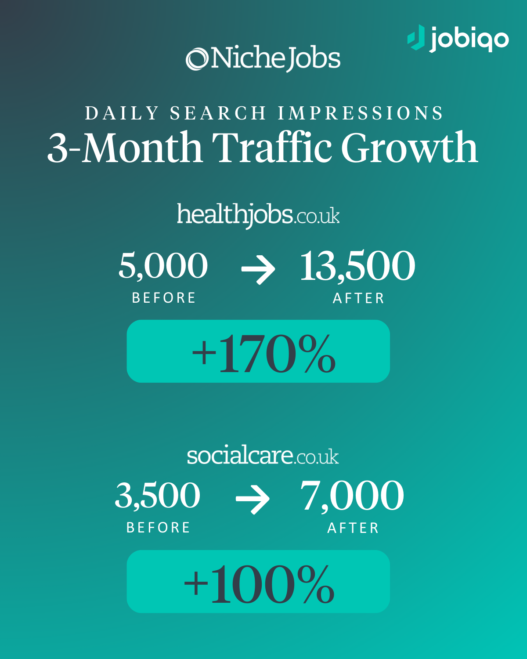
Meanwhile,  healthjobs.co.uk and socialcare.co.uk saw almost instant improvements in Google Search impressions, indicating that Google picked up the newly structured, cleaner content quickly:​ 

By late December, a clear upward trend appeared across all four sites in Google Search appearances and revealed that the short‑term migration losses were fully recovered, and the trajectory turned decisively positive.

Keyword Ranking Improvements

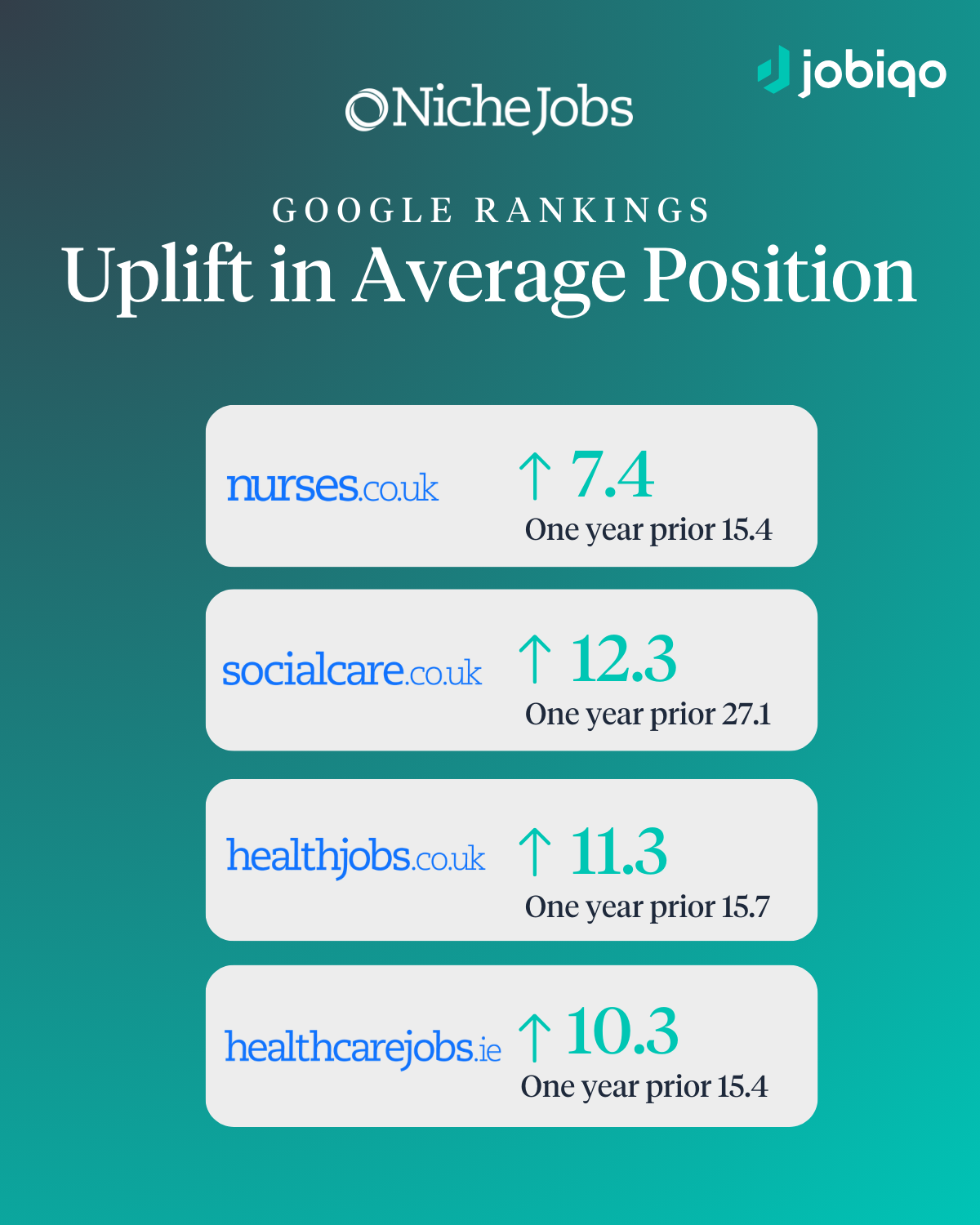
Tracking core healthcare recruitment search phrases, the average Google Search positions were compared to those in January 2025 with those in January 2026 to see how the migration and strategy shifts had influenced rankings over the year:

Image presenting uplift in the average google rankings position

These stats signal a structural improvement in how Google interprets the sites’ relevance and authority for high‑intent queries.

Discover why putting quality over volume drives better recruiting outcomes in our “Job Board Revolution” report and why the window to adapt is closing fast.

The Underlying Principles

This wasn’t about tactical tweaks. It was a strategic realignment around three core beliefs:

  • Relevance beats reach
    Google rewards sites that clearly serve a specific intent. By narrowing focus, geographically and topically, Niche Jobs strengthened their relevance signals.
  • User experience is an SEO factor
    Faster load times, clearer navigation, and fewer application barriers don’t just help candidates, they also send positive engagement signals to search algorithms.
  • Data discipline over vanity metrics
    Choosing to measure success by qualified applications rather than raw traffic or CV uploads forced strategic decisions.

Key Takeaways for Recruitment Platforms

Audit your traffic quality, not just volume
If a significant portion of your audience can’t convert for your clients, you may want to consider reducing that traffic.

Specialisation compounds SEO authority
Google increasingly favours sites with clear topical focus. Don’t dilute your domains trying to be everything to everyone.

Friction leads to drop‑off
Evaluate every step in the candidate journey and ask: “Does this step help the candidate, or does it exist to help us collect data?” If it’s the latter, streamline or remove it. Reducing friction at key points drives more completed applications.

Migration is an opportunity, not just a task
Platform changes are disruptive but they’re also rare chances to reset technical debt, taxonomy, and user flows.

✅ Relevant applications drive better feedback
When candidates match the role, recruiters spend less time filtering out irrelevant CVs and more time engaging with top talent. The difference quality makes is clear and everyone notices it.

Get in touch and discover how Jobiqo can help take your job board to the next level.

Must-Attend Events for Job Board Owners in 2026

Must-Attend Events for Job Board Owners in 2026

Every year, the HR and job market industry offers an overwhelming number of conferences. Choosing which ones are truly worth your time isn’t easy. In 2025 alone, Jobiqo attended more than 30 conferences worldwide, so chances are, we’ve already done the legwork for you.

Based on our experience, here are our must-attend events for 2026 for both existing and aspiring job board owners.

The Future of German Media
March 11–12, 2026
📍 Hanover
A summit focused on exchange, innovation, and the future of quality journalism. The Future of German Media brings together leading figures from newsrooms, publishing houses, and the digital economy to explore the key success factors for journalism in the digital age.

Zukunft Personal Nord (ZP Nord)
March 25–26, 2026
📍 Hamburg
The northern regional edition of Europe’s leading HR expo series, ZP Nord connects HR professionals with innovative solutions, emerging trends, and practical tools across the HR ecosystem

RecBuzz Conference
April 15–16, 2026
📍 Budapest
🎟️ €200 discount with code: JOBIQO200
Focus: Global recruiting marketplaces and job boards
RecBuzz, organised by the AIM Group, is a key gathering in the recruitment industry. The conference addresses industry change and strategies for staying ahead, offering valuable networking opportunities with potential partners, investors, and industry experts. Attendees engage in discussions around challenges and opportunities for recruitment platforms. Held annually in different European cities, RecBuzz 2026 will take place in Budapest.

Zukunft Personal Süd (ZP Süd)
April 21–22, 2026
📍 Stuttgart
Another regional edition of Europe’s leading HR expo series, ZP Süd continues the mission of connecting HR professionals with innovative solutions, emerging trends, and practical tools across the HR ecosystem.

TAtech North America
May 6–8, 2026
📍 Charleston, South Carolina
🎟️ 10% discount with code: tatech10
Focus: North America and global recruiting marketplaces, job boards, recruiting tech, and HR tech
TAtech North America & The World Job Board Forum is a unique conference dedicated entirely to job boards, talent marketplaces, and talent technology solutions. Now in its 19th year, it covers ATS, CRM, conversational AI, recruitment advertising, marketing, and assessment products. Unlike traditional HR events, speakers are experienced business leaders, ensuring highly practical and relevant discussions.

Job Boards Connect – Unplugged
May 14, 2026
📍 London
🎟️ 10% discount with code: Jobiqo10
Focus: UK and global recruiting marketplaces and job boards
The Unplugged edition is known for its highly engaging format: no PowerPoint, no formal presentations—just open conversations and peer learning with industry, technology, sales, and marketing experts.
Job Boards Connect will also host the DJAx Digital Job Advertising Excellence Awards on the evening of May 14, offering job boards and vendors additional recognition for their impact on the job market.
The conference is organised by Louise Grant and Louise Triance, highly respected figures in the online recruitment industry and long-standing advocates for the job board ecosystem.

European Publishing Congress
June 17–18, 2026
📍 Vienna
Focus: Germany, Austria, Switzerland (German-language event)
The European Publishing Congress brings together Europe’s leading media professionals to present strategies, share insights, and discuss the future of the publishing industry.

TALENTpro
June 17–18, 2026
📍 Munich
TALENTpro is an expo festival that brings fresh ideas, strong community vibes, and the hottest recruiting trends to one stage. With its festival-like atmosphere, it offers a refreshing alternative to traditional trade fairs while maintaining a strong focus on exchange, innovation, and networking.

Zukunft Personal Europe (ZP Europe)
September 15–17, 2026
📍 Cologne
ZP Europe is the flagship event of the Zukunft Personal series and the largest HR expo in Europe. It provides unparalleled access to the full HR landscape, connecting established market leaders with innovative startups and future-facing solutions.

Job Boards Connect – Main Conference
October 8, 2026
📍 London
🎟️ 15% discount with code: Jobiqo15
The October edition follows a more traditional conference format, featuring keynote speakers, panel discussions, and on-stage insights from job board leaders and industry experts, all focused on the future of online recruitment.

Meet Jobiqo on the Road

Join us at these events and connect with the Jobiqo team in person. We’re looking forward to meeting you, exchanging ideas, and discussing how we can support your job board growth.


Stay tuned and follow us on LinkedIn to see where our team will be throughout the year.

Job Board Revolution? Are Job Boards Solving the Wrong Problem…

Commissioned by Jobiqo | Author: Lou Goodman

In January 2026, InfoJobs Italy shut down after two decades, crushed between Indeed’s aggregation power and LinkedIn’s network effects. This wasn’t market saturation or a casualty of a shrinking labor market. It was something far more fundamental and far more preventable …

It was marketing myopia: a company that defined itself as a job posting platform failed to realize it was actually a recruitment marketplace. That narrow self-definition limited its ability to evolve as the market shifted around it.

Theodore Levitt’s saw this coming decades ago and his classic warning has never felt more relevant:

“Railroads did not stop growing because the need for transportation declined. They stopped growing because management defined themselves as being in the railroad business rather than the transportation business.”

Job boards are making the same mistake. They focus on displaying job postings but postings aren’t the real problem customers are trying to solve:

  • Employers don’t need more applications. They need applications that convert to hires.

  • Job seekers don’t need more jobs to apply to. They need applications that convert to offers.

Moving Beyond Marketing Myopia

The traditional job board model worked when candidates applied selectively and stayed in roles for years. Today, those assumptions no longer hold, and platforms built around clicks and raw volume are struggling. The boards that succeed are the ones redefining success around recruiting outcomes:

Myopic Definition → Recruiting Outcomes-Focused

“We sell job postings” → “We enable employers to reach qualified candidates”

“We drive applicant volume” → “We deliver qualified candidates”

“We list opportunities” → “We help candidates discover roles that match their skills”

The contrast is clear. Platforms that focus on recruiting outcomes don’t just process applications, they create real value for both employers and job seekers. Those job boards won’t just survive, they’ll expand their advantage in a market that increasingly rewards quality over quantity. 

On the other hand, platforms measuring success by transactional metrics, number of job postings, applications submitted, or impressions served, are on a slow path to irrelevance. This isn’t a minor shift, it’s the difference between leading the market and being left behind. 

So, the real question isn’t anymore: “How do we get more clicks?” It’s: What outcomes are we actually delivering?

Job Boards at a Crossroads: A Timely Strategic Report

Our Job Board Revolution? Are Job Boards Solving the Wrong Problem… report examines this shift in detail, focusing on four forces that are redefining the job board model:

Defining Quality: Why employers and candidates see “quality” differently, and how misalignment drives volume over outcomes.
Power and Control: Who really owns the hiring transaction, and how infrastructure giants are reshaping the market.
Design, Trust, and Market Behavior: How short-term monetisation choices impact long-term trust and defensible positioning.
External Forces and Internal Choices: How collective behaviours created systemic dysfunction and where smart platforms can reclaim relevance.

Read the full report to discover how to transform from a transactional job board into a platform that drives recruiting outcomes.

Jobiqo Expands Advisory Board with Lou Goodman and Bernhard Deussner

As job boards and talent marketplaces enter a new era shaped by AI, automation, and shifting candidate behavior, Jobiqo’s mission is clear: to help leading job sites move beyond simply “posting jobs” toward delivering measurable recruiting outcomes through better matching, stronger reach, and outcome-based commercial models. To strengthen this mission and bring additional strategic insight, Jobiqo is pleased to welcome Lou Goodman and Bernhard Deussner to the Advisory Board.

Lou Goodman brings more than 20 years of recruitment marketing experience across agencies, platforms, and global media organisations. Having started her career at Barkers and TMP, held senior roles at MediaCom, Manning Gottlieb OMD and most recently as VP Global B2B Marketing at Monster, she combines consumer brand-building discipline with systems thinking for B2B growth. Lou also authored Jobiqo’s recent strategic report, “Job Board Revolution? Are job boards solving the wrong problem …”, helping define how job boards can evolve into modern, high-performance recruiting ecosystems.

Bernhard Deussner brings deep experience in scaling HR technology platforms globally. Over 14 years at Indeed, he held senior leadership roles across Austin, Dublin, and Singapore, supported expansion into 15 markets, and helped architect long-range planning and operational execution at scale. As a GTM leader with strong expertise in marketplace transformations and the DACH HR Tech landscape, Bernhard bridges strategic vision with commercial and organisational delivery across the US, EMEA, and APAC.

“Lou and Bernhard bring exactly the kind of strategic and operational perspective we need as we continue to scale Jobiqo in our core markets. They understand how talent marketplaces win today: by building trust, reaching audiences efficiently, and turning signals into outcomes, for employers, candidates, and the platforms that connect them.”
Martin Lenz, CEO of Jobiqo

Their appointments come at a crucial moment for Jobiqo, following the acquisition of JOBS.DE, which strengthens Jobiqo’s position in the German market and accelerates its ambition to build a modern, outcome-driven job marketplace at scale. Bernhard’s experience in building and executing go-to-market strategies across international and European markets, combined with his understanding of the HR Tech ecosystem, will be especially valuable as Jobiqo expands JOBS.DE and deepens its presence across DACH.

With Lou and Bernhard joining the Advisory Board, we are further strengthening our ability to serve job boards and media brands across 25 countries as they modernise their platforms, unlock new revenue models, and build the next generation of AI-enabled hiring experiences. We look forward to collaborating with Lou and Bernhard, whose insights will challenge and strengthen our strategic direction for Jobiqo and JOBS.DE.

Learn more about Jobiqo's industry thought leadership in the Job Board Revolution Report created together with Lou Goodman.

Jobiqo acquires JOBS.DE and strengthens the job network in Germany

Jobiqo acquires JOBS.DE, strengthening its presence in the German job market. JOBS.DE will be further developed technologically and receive an AI-based performance upgrade.

Jobiqo, a leading technology and full-service provider for online job boards, has acquired the JOBS.DE platform from the Kariera Group. With this acquisition, Jobiqo strengthens its presence in the German market and further establishes itself as a central technology partner for publishers, media houses, professional associations, universities, and operators of online job boards. At the same time, JOBS.DE will receive a significant performance upgrade through Jobiqo’s AI-powered reach and matching technologies.

The online recruiting market is undergoing a structural transformation. Artificial intelligence, programmatic job advertising, rising media costs, and increasing AI-driven applicant and bot traffic are fundamentally changing the requirements for online job boards. Employers are increasingly expecting integrated solutions that combine reach, relevance, and measurable results—relying less on external reach channels.

In this context, JOBS.DE will be further enhanced as a key component of Jobiqo’s national job board network. The platform will continue to operate independently, strategically linking national reach with regional and specialized job markets to deliver greater impact and relevance.

"The online job market is increasingly driven by technology and managed across multiple channels. Artificial intelligence and social media deliver their full potential when used in a coordinated way. With the further development of JOBS.DE, we are putting this approach into practice, while simultaneously strengthening the entire Jobiqo network by providing additional reach, improved control, and higher-quality matching results exclusively for our job boards."
Martin Lenz, CEO of Jobiqo

The focus is on delivering high-quality recruiting outcomes: employers should not only gain visibility, but also receive more relevant applications, structured processes, and measurable results throughout the entire recruiting funnel.

More Options for Publishers and Job Board Operators

With the integration of JOBS.DE, Jobiqo expands its job board network with a national reach component that can be strategically linked with regional and specialized online job boards. This creates additional reach within a controlled, technology-driven network focused on quality and measurable results.

For publishers and platform operators, this means greater independence from external reach channels as well as improved control over performance and recruiting outcomes. The integration is based on existing Jobiqo technology, such as Jobiqo AIR.

Learn more about Jobiqo's industry thought leadership in the Job Board Revolution Report created together with Lou Goodman.

Technology and Performance Upgrade for JOBS.DE

For JOBS.DE, the acquisition marks a comprehensive technological upgrade, delivering noticeable performance improvements for employers. The platform will be further developed using Jobiqo’s technology and international expertise, benefiting from a technology stack fully focused on performance, quality, and scalability. This includes the targeted use of data and artificial intelligence, AI-powered Search&Match Technology, intelligent reach management, social recruiting approaches, and continuous conversion optimization.

"The goal is to adapt JOBS.DE specifically to the evolving requirements of the online recruiting market and to develop it sustainably for the long term, with a focus on delivering relevant recruiting outcomes for employers. We have observed that job boards supported by Jobiqo technology achieve more than twice the conversion rate of qualified applicants compared to traditional job aggregators. We now aim to offer this performance advantage to all our clients within the job market network and continue to expand it."
Matthias Hutterer, CTO of Jobiqo

About Jobiqo

Jobiqo is a global technology provider for online job boards, headquartered in Vienna. In Germany alone, the company powers over 150 job portals and partners with several leading German publishing groups, helping regional and national media brands strategically develop their job boards and build sustainable recruiting solutions. In early 2023, Jobiqo further expanded its offerings with Jobiqo AIR, a cross-channel programmatic job advertising service.

Internationally, Jobiqo has supported publishers, media houses, associations, universities, and specialized platform operators for more than 14 years in building, operating, and enhancing modern online job boards. To date, over 400 job boards worldwide have been realized using Jobiqo technology, including platforms of renowned media and market players such as The New York Times.

About JOBS.DE

JOBS.DE is an online job board in the German market with a long-standing market presence and a strong candidate base. The platform was once among the largest job boards in the German market and was most recently part of the Kariera Group. As part of the Jobiqo job board network, JOBS.DE will be technologically upgraded and strategically adapted to the evolving requirements of the online recruiting market—with a focus on reach, relevance, and measurable recruiting outcomes.

A New Chapter for LoveLocalJobs: Powered by Jobiqo

A New Chapter for LoveLocalJobs: Powered by Jobiqo

We’re thrilled to welcome LoveLocalJobs.com to the Jobiqo platform, a respected brand that has been connecting people to meaningful opportunities across Brighton and Sussex for over a decade.

Founded with a mission to connect local people with purpose-led work, LoveLocalJobs has built a trusted reputation within its community. Now, they’re embracing a new era of growth and innovation by partnering with Jobiqo to enhance their digital capabilities and job seeker experience.

The migration will include all three of their regional sites: LoveLocalJobs.com, BrightonandHoveJobs.com, and The Manor Royal Jobs Board, all moving to Jobiqo’s modern, flexible job board technology.

“We’ve been on our existing technology since 2015. Over time, the recruitment landscape and candidate expectations have evolved dramatically. We knew it was the right moment to invest in a platform that supports our vision for the future. That’s why we chose Jobiqo.”
Claire Beech, LoveLocalJobs

Empowering the Future of Local Hiring

The team at LoveLocalJobs conducted a full review of their platform needs and strategic direction. Their priority: finding a technology partner that aligns with their ambition to grow and innovate.

By moving to Jobiqo, LoveLocalJobs will benefit from:

Seamless, mobile-first candidate experience

LoveLocalJobs and Jobiqo share a strong commitment to supporting regional employers and jobseekers with the best possible tools. This new partnership represents more than a platform upgrade, it’s a shared investment in the future of local recruitment.

“We want to empower job boards to focus on what they do best: connecting people with great opportunities. LoveLocalJobs has a clear vision, and we’re excited to support them with our technology that will help them move faster and smarter, without added complexity.”
Martin Lenz, CEO, Jobiqo

What’s Next Starts Now

At Jobiqo, we specialise in helping niche and regional job boards thrive in a rapidly changing market. We’re proud to welcome LoveLocalJobs to our growing network of partners and look forward to supporting their next phase of growth.

About the companies

Founded in 2010, LoveLocalJobs is a purpose-driven job board network dedicated to connecting local people with meaningful career opportunities across Brighton, Sussex, and the wider South East region. Through platforms like LoveLocalJobs.com, BrightonandHoveJobs.com, and The Manor Royal Jobs Board, they’ve become a trusted voice for local employers and jobseekers alike, championing employability, community impact, and inclusive growth.

Jobiqo enables media brands, associations, publishers, and recruitment agencies worldwide to build next-generation job boards and career marketplaces. With over 350 platforms launched across 25+ countries, Jobiqo powers more than 10 million job application starts annually. Its modular product suite includes white-label job board software, AI-powered search and match technology, and Jobiqo AIR, an automated, multi-channel programmatic advertising solution.

Curious what Jobiqo can do for your job board?

Whatchado and Jobiqo Combine Video and AI to Boost Social Media Recruiting

New partnership brings together short-form video content and intelligent reach automation for next-level social recruiting

Whatchado, the leading video-first job platform, and Jobiqo, provider of modular job board technology, have entered a strategic partnership to reshape social media recruiting. Their shared vision: to merge authentic short-form video content with AI-driven campaign automation for more visibility, engagement, and performance.

Whatchado has launched whatchado Reals, a new product featuring short, mobile-optimised video job ads built for platforms like Instagram, TikTok, and LinkedIn—ideal for reaching passive candidates with real, relatable content. These videos are enhanced by Jobiqo AIR (Automated Intelligent Reach), which distributes job ads automatically and intelligently across aggregators, Google, and all key social channels.

For existing Jobiqo clients, the integration is seamless – no technical changes required. This enables even smaller recruiting teams or publishers to expand into high-impact video recruiting with minimal effort.

“With whatchado Reals, we’re filling a gap in the market. We deliver high-quality, mobile-optimised video content right where target groups spend their time. Combined with Jobiqo AIR, we’ve created a product that’s not just innovative, it delivers results instantly.”
Jubin Honarfar, CEO whatchado

Benefits for Jobiqo clients

Existing Jobiqo customers can easily integrate whatchado Reals into their campaigns without any system changes or additional interfaces. The integration is seamless and supports the growing demand for social media recruiting with minimal effort. The collaboration is especially attractive for job boards, publishers, and media companies looking to offer modern recruiting solutions without using their own internal resources.

Joint value proposition

By joining forces, whatchado and Jobiqo deliver a scalable system tailored to the needs of today’s job boards and recruiting teams:

  • Shared data and market strengths from two leading HR tech providers
  • AI-generated content and visuals that save significant time
  • Automated, data-driven, targeted distribution
  • Continuous campaign optimisation using secure performance data
  • Resource-efficient, scalable, and ready to use immediately

The result: Real storytelling meets AI automation – delivering scalable, data-driven recruiting solutions for the social age.

“Jobiqo is the technological enabler for smart recruiting. Our clients benefit twice: they save time through automated campaign control and increase impact through real storytelling. Together, we’re opening new channels, engaging passive candidates, and taking social recruiting to the next level.”
Martin Lenz, CEO Jobiqo

About the companies

Whatchado is a leading video job platform and employer branding provider in the DACH region. With over 10,000 employee videos from more than 600 employers, it offers authentic insights into jobs and company culture. In 2024, it expanded to include data-driven job ads in Reels format. www.whatchado.com

Jobiqo provides modular job board technology to clients across Europe and North America, including The New York Times, speciality publishers, universities, and recruiting platforms. Its Jobiqo AIR system enables automated reach expansion across all major online channels. www.jobiqo.com

Jobiqo CEO Martin Lenz with Whatchado CEO Jubin Honarfer